Next: Maxwell's equations
Up: Lecture_16_web
Previous: The Divergence Theorem
Next: Maxwell's equations
Up: Lecture_16_web
Previous: The Divergence Theorem
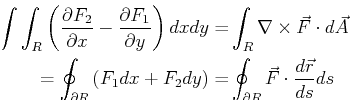
The final generalization of the fundamental theorem of calculus is the relation between a vector function integrated over an oriented surface and another vector function integrated over the closed curve that bounds the surface.
A simplified version of Stokes's theorem has already been discussed--Green's theorem in the plane can be written in full vector form:
 lies entirely in the
 constant
plane.
constant
plane.
In fact,
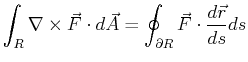
Stokes's theorem is the same as the full vector form in Eq. 16-7
with
generalized to an oriented surface embedded in three-dimensional space:
 |
(16-8) |
Plausibility for the theorem can be obtained from Figures 16-1 and 16-2. The curl of the vector field summed over a surface ``spills out'' from the surface by an amount equal to the vector field itself integrated over the boundary of the surface. In other words, if a vector field can be specified everywhere for a fixed surface, then its integral should only depend on some vector function integrated over the boundary of the surface.