
 Next: Multidimensional Integrals
Up: Lecture_14_web
Previous: Lecture_14_web
Next: Multidimensional Integrals
Up: Lecture_14_web
Previous: Lecture_14_web
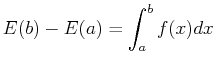
Consider the type of integral that everyone learns initially:
 |
(14-1) |
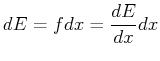
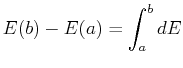
The equation implies that  is integrable and
 |
(14-2) |
 |
(14-3) |
 and
and  represent ``points'' on some line
where
represent ``points'' on some line
where  is to be evaluated.
Of course, there is no reason to restrict integration to a
straight line--the generalization is the integration
along a curve (or a path)
 .
.
that has the gradient
 .
.
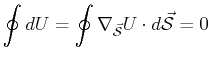
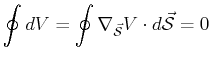
If the function being integrated along a simply-connected path (Eq. 14-4) is a gradient of some scalar potential, then the path between two integration points does not need to be specified: the integral is independent of path. It also follows that for closed paths, the integral of the gradient of a scalar potential is zero.1 A simply-connected path is one that does not self-intersect or can be shrunk to a point without leaving its domain.
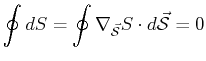
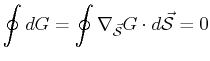
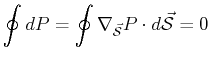
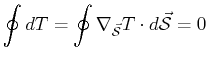
There are familiar examples from classical thermodynamics of simple one-component fluids that satisfy this property:
 |
 |
 |
(14-5) |
 |
 |
 |
(14-6) |
 is any other set of variables that sufficiently
describe the equilibrium state of the system (i.e,
is any other set of variables that sufficiently
describe the equilibrium state of the system (i.e,  ,
,  ,
,
 ,
,  for
for  describing a simple one-component fluid).
The relation
curl grad 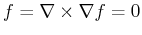 provides method for testing whether some general
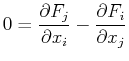
 is independent of path. If
 |
(14-7) |
 |
(14-8) |
 ,
,  ,
then
is independent of path.
These are the Maxwell relations of classical thermodynamics.
,
then
is independent of path.
These are the Maxwell relations of classical thermodynamics.
MATHEMATICA Example
 |
| (notebook Lecture-14) |
| (html Lecture-14) |
| (xml+mathml Lecture-14) |
| Path Dependence, Curl, and Curl=0 subspaces
This
example will show that the choice of path matters for
a vector-valued function that does not have vanishing curl
and that it doesn't matter when integrating a function with
vanishing curl.
|

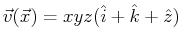 does not have vanishing curl.
 along a path that is wrapped around a cylinder of
radius
along a path that is wrapped around a cylinder of
radius  , (e.g.,
 ,
where
,
where
 )
)
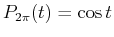 ,
,
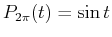 ,
,
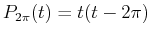 , and
, and
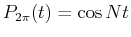 .
.
 ,
,
 .
In fact,
.
In fact,
 .
.
 along the same cylindrical-type path as above
and see that the integral always vanishes--it is path-independent.
along the same cylindrical-type path as above
and see that the integral always vanishes--it is path-independent.
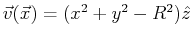 only vanishes on the cylinder or radius
  :
:
![$\displaystyle \vec{w} = \frac{1}{2} \left(
y R^2 \left[1 - x^2 - \frac{y^2}{3}\right] \hat{x}+
-x R^2 \left[1 - y^2 - \frac{x^2}{3}\right] \hat{y}
\right)
$](img45.png)
 --the vector function