
 Next: Curl and Its Interpretation
Up: Lecture_13_web
Previous: Generalizing the Derivative
Next: Curl and Its Interpretation
Up: Lecture_13_web
Previous: Generalizing the Derivative
 system.
Sometimes it is more convenient to work in other (spherical,
cylindrical, etc) coordinate systems.
In other coordinate systems, the derivative operations
system.
Sometimes it is more convenient to work in other (spherical,
cylindrical, etc) coordinate systems.
In other coordinate systems, the derivative operations
 ,
,
 , and
, and
 have different
forms.
These other forms can be derived, or looked up in a mathematical handbook,
or specified by using the
MATHEMATICA
have different
forms.
These other forms can be derived, or looked up in a mathematical handbook,
or specified by using the
MATHEMATICA package ``VectorAnalysis.''
|
MATHEMATICA
Example |
| (notebook Lecture-13) |
| (html Lecture-13) |
| (xml+mathml Lecture-13) |
| Coordinate System Transformations
|
The divergence operates on a vector field that is
a function of position,
 =
=
 =
=
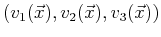 ,
and returns a scalar that is a function of position.
The scalar field is often called the divergence field of
,
and returns a scalar that is a function of position.
The scalar field is often called the divergence field of
 or simply the divergence of
.
or simply the divergence of
.
div  |
(13-2) |
Think about what the divergence means,