Next: Index
Up: Lecture_13_web
Previous: Divergence and Its Interpretation
Next: Index
Up: Lecture_13_web
Previous: Divergence and Its Interpretation
The curl is the vector valued derivative of a vector function. As illustrated below, its operation can be geometrically interpreted as the rotation of a field about a point.
For a vector-valued function of  :
:
 |
(13-3) |
the curl derivative operation is another vector defined by:
curl  |
(13-4) |
curl 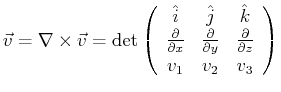 |
(13-5) |
MATHEMATICA Example
 |
| (notebook Lecture-13) |
| (html Lecture-13) |
| (xml+mathml Lecture-13) |
| Calculating the Curl of a Function
Consider the vector function that is often used in Brakke's
Surface Evolver program:

This can be shown easily, using MATHEMATICA
, to have
the property:

which is spherically symmetric for  and
convenient for turning surface integrals over
a portion of a sphere into a path-integral over
a curve on a sphere.
and
convenient for turning surface integrals over
a portion of a sphere into a path-integral over
a curve on a sphere.
|
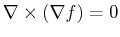
One important result that has physical implications is
that a the curl of a gradient is always zero:
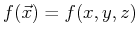 :
:
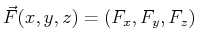 can be
derived from a scalar potential,
can be
derived from a scalar potential,
 , then
the curl of
, then
the curl of  must be zero.
This is the property of an exact differential
must be zero.
This is the property of an exact differential
 .
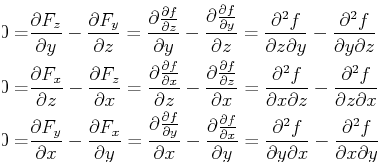
Maxwell's relations follow from equation 13-6:
.
Maxwell's relations follow from equation 13-6:
 |
(13-7) |
Another interpretation is that gradient fields are curl free, irrotational, or conservative.
The notion of conservative means that, if a vector function can be derived as the gradient of a scalar potential, then integrals of the vector function over any path is zero for a closed curve--meaning that there is no change in ``state;'' energy is a common state function.
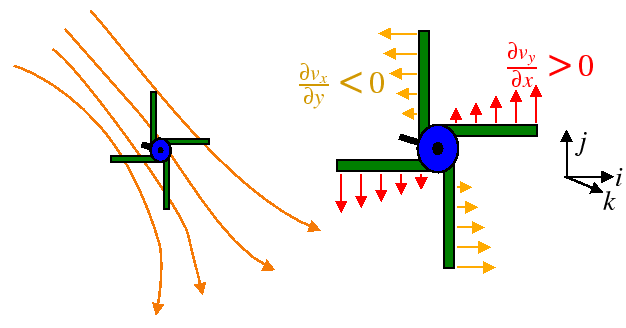
Here is a picture that helps visualize why the curl invokes names associated with spinning, rotation, etc.

|
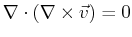
Another important result is that divergence of any curl is
also zero, for
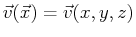 :
:
 above and visualize using
the PlotVectorField3D function in
MATHEMATICA
above and visualize using
the PlotVectorField3D function in
MATHEMATICA along the
  ,
this singularity will be communicated during the numerical
evaluations for visualization unless some care is applied.
,
this singularity will be communicated during the numerical
evaluations for visualization unless some care is applied.
 .
.
 component is an increasing function of
  , this
tends to make the paddle wheel want to spin (positive, counter-clockwise)
about the
, this
tends to make the paddle wheel want to spin (positive, counter-clockwise)
about the  -axis.
If the
-axis.
If the  component is a decreasing function of
  , this
tends to make the paddle wheel want to spin (positive, counter-clockwise)
about the
, this
tends to make the paddle wheel want to spin (positive, counter-clockwise)
about the  const.
and
the local acceleration
const.
and
the local acceleration
 can subtracted
because of Eq.
can subtracted
because of Eq.