
 Next: Total and Partial Derivatives, Chain Rule
Up: Lecture_12_web
Previous: The Calculus of Curves
Next: Total and Partial Derivatives, Chain Rule
Up: Lecture_12_web
Previous: The Calculus of Curves
In materials science and engineering, the concept of a spatially varying function arises frequently:
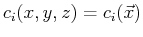 is the
number (or moles) of chemical species of type
is the
number (or moles) of chemical species of type  per unit volume located at the point
  .
.
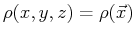 mass per unit volume located at the point
.
a point
.
mass per unit volume located at the point
.
a point
.
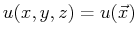 energy
per unit volume located at the point
.
energy
per unit volume located at the point
.
There are also spatially variable intensive quantities:
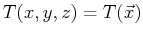 is the temperature
which would be measured at
the point
.
is the temperature
which would be measured at
the point
.
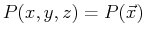 is the pressure
which would be measured at
the point
.
is the pressure
which would be measured at
the point
.
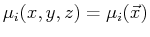 is the chemical potential of the species
which would be measured at
the point
.
is the chemical potential of the species
which would be measured at
the point
.
Each example is a scalar function of space--that is, the function associates a scalar with each point in space.
A topographical map is a familiar example of a graphical illustration of a scalar function (altitude) as a function of location (latitude and longitude).
However, there are many other types of scalar functions of
several arguments, such as the state function:
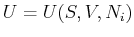 or
or
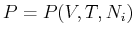 .
It is sometimes useful to think of these types of functions a scalar
functions of a ``point'' in a thermodynamics space.
.
It is sometimes useful to think of these types of functions a scalar
functions of a ``point'' in a thermodynamics space.
However, this is often a source of confusion: notice that
the internal energy is used in two different contexts above.
One context is the value of the energy, say 128.2 Joules.
The other context is the function
 .
While the two symbols are identical, their meanings are quite different.
.
While the two symbols are identical, their meanings are quite different.
The root of the confusion lurks in the question, ``What are the
variables of  ?''
Suppose that there is only one (independent) chemical species, then
?''
Suppose that there is only one (independent) chemical species, then  has
three variables, such as
has
three variables, such as  .
``But what if
.
``But what if
 ,
,
 , and
, and
 are known functions, what are the variables
of
?''
The answer is, they are any three independent variables, one
could write
are known functions, what are the variables
of
?''
The answer is, they are any three independent variables, one
could write
 and there are six other natural choices.
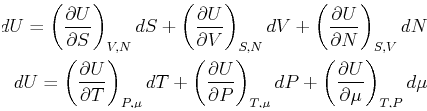
The trouble arises when variations of a function like
are
queried--then the variables that are varying must be
specified.
For this reason, it is either a good idea to keep the functional form explicit in thermodynamics, i.e.,
 |
(12-6) |
 |
(12-7) |