Next: Scalar Functions with Vector Argument
Up: Lecture_12_web
Previous: Lecture_12_web
Next: Scalar Functions with Vector Argument
Up: Lecture_12_web
Previous: Lecture_12_web
 , were considered.
It is natural to think of
as
a curve in whatever space the vector
, were considered.
It is natural to think of
as
a curve in whatever space the vector  is
defined.
In this way, a curve is represented by
is
defined.
In this way, a curve is represented by  coordinates as a single value takes
on a range of numbers.
coordinates as a single value takes
on a range of numbers.
MATHEMATICA Example
 |
| (notebook Lecture-12) |
| (html Lecture-12) |
| (xml+mathml Lecture-12) |
| Curves, Tangents, Surfaces
|
Because the derivative of a curve with respect to its parameter is a tangent vector, the unit tangent can be defined immediately:
It is convenient to find a new parameter,  , that
would make the denominator in Eq. 12-1 equal
to one.
This parameter,
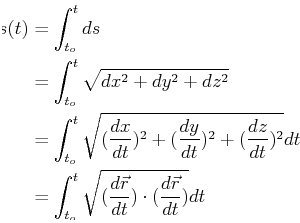
, is the arc-length:
, that
would make the denominator in Eq. 12-1 equal
to one.
This parameter,
, is the arc-length:
 instead of
  ,
,
 |
(12-3) |
 and
have the
same units (i.e., meters and meters, foots and feet, etc) instead
of, for instance, time,
, that makes
and
have the
same units (i.e., meters and meters, foots and feet, etc) instead
of, for instance, time,
, that makes
 a
velocity and involving two different kinds of units (e.g.,
furlongs and hours).
a
velocity and involving two different kinds of units (e.g.,
furlongs and hours).
With the arc-length
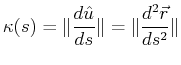
, the magnitude of the curvature is particularly
simple,
 |
(12-4) |
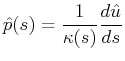
Furthermore, the rate at which the unit tangent changes direction is
a vector that must be normal to the tangent (because
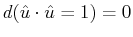 ) and therefore the unit normal
is defined by:
) and therefore the unit normal
is defined by:
 |
(12-5) |
There two unit vectors that are locally normal
to the unit tangent vector
 and the curve unit normal
 and
and
 .
This last choice is called the unit binormal,
.
This last choice is called the unit binormal,
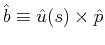 and the
three vectors together form a nice little moving orthogonal
axis pinned to the curve.
Furthermore, there are convenient relations between the vectors and differential
geometric quantities called the Frenet equations.
and the
three vectors together form a nice little moving orthogonal
axis pinned to the curve.
Furthermore, there are convenient relations between the vectors and differential
geometric quantities called the Frenet equations.
However, it should be pointed out that--although re-parameterizing a curve in terms of its arc-length makes for simple analysis of a curve--achieving this re-parameterization is not necessarily simple.
Consider the steps required to represent a curve
in
terms of its arc-length:
.
If it does then we can perform the following operation:
is typically a complicated function that is not
easy to invert, i.e., solve for
in terms of
to
get a  that can be substituted into
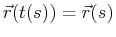 .
.
These difficulties usually result in treating the problem symbolically and the resorting to numerical methods of achieving the integration and inversion steps.
|
MATHEMATICA
Example |
| (notebook Lecture-12) |
| (html Lecture-12) |
| (xml+mathml Lecture-12) |
| Calculating arclength
|