
 Next: Exponentiation and Relations to Trignometric Functions
Up: Lecture_08_web
Previous: Complex Numbers and Operations in the Complex Plane
Next: Exponentiation and Relations to Trignometric Functions
Up: Lecture_08_web
Previous: Complex Numbers and Operations in the Complex Plane
There are physical situations in which a transformation from
Cartesian ( ) coordinates to polar (or cylindrical) coordinates
(
) coordinates to polar (or cylindrical) coordinates
( )
simplifies the algebra that is used to describe the
physical problem.
)
simplifies the algebra that is used to describe the
physical problem.
An equivalent coordinate transformation for complex numbers,
 , has an analogous simplifying effect for multiplicative operations
on complex numbers.
It has been demonstrated how the complex conjugate,
, has an analogous simplifying effect for multiplicative operations
on complex numbers.
It has been demonstrated how the complex conjugate,  , is
related to a reflection--multiplication is related to a counter-clockwise
rotation in the complex plane.
Counter-clockwise rotation corresponds to increasing
, is
related to a reflection--multiplication is related to a counter-clockwise
rotation in the complex plane.
Counter-clockwise rotation corresponds to increasing  .
.
The transformations are:
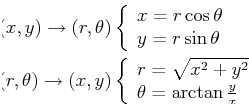 |
(08-4) |
![$ \arctan \in (-\pi,\pi]$](img29.png) .
.
One advantage of the polar complex form is the simplicity of
multiplication operations:
 |
(08-5) |
![$\displaystyle \sqrt[n]{z} = \sqrt[n]{z} (\cos \frac{\theta + 2 k \pi}{n} + \imath \sin \frac{\theta + 2 k \pi}{n})$](img31.png) |
(08-6) |
MATHEMATICA Example
 |
| (notebook Lecture-07) |
| (html Lecture-07) |
| (xml+mathml Lecture-07) |
| Polar Form of Complex Numbers
|