Link to Current (updated) notes

next previous Next: Index Up: Lecture_08_web Previous: Polar Form of Complex Numbers

Exponentiation and Relations to Trignometric Functions

Exponentiation of a complex number is defined by:

$\displaystyle e^z = e^{x + iy} = e^x (\cos y + \imath \sin y)$ (08-7)


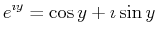
Exponentiation of a purely imaginary number advances the angle by rotation:
$\displaystyle e^{\imath y} = \cos{y} + \imath \sin{y}$ (08-8)

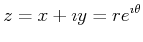
combining Eq. 8-8 with Eq. 8-7 gives the particularly useful form:

$\displaystyle z = x + \imath y = r e^{\imath \theta}$ (08-9)

and the useful relations (that can be obtained simply by considering the geometry of the complex plane)

\begin{displaymath}\begin{array}{lllll} e^{2 \pi \imath} = 1 & e^{\pi \imath} = ...
...ath} = \imath & e^{-\frac{\pi}{2} \imath} = -\imath \end{array}\end{displaymath} (08-10)

Judicious subtraction of powers in Eq. 8-8 and generalization gives the following useful relations for trigonometric functions:
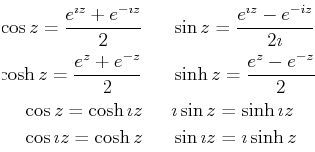
\begin{displaymath}\begin{split}\cos z = \frac{e^{\imath z} + e^{-\imath z}}{2} ...
... z \hspace{0.25in} & \sin \imath z = \imath \sinh z \end{split}\end{displaymath} (08-11)

MATHEMATICA$ ^{\text{\scriptsize {\textregistered }}}$ Example
(notebook Lecture-07)
(html Lecture-07)
(xml+mathml Lecture-07)
Numerical precision and rounding of complex numbers
Roots of polynomial equations


© W. Craig Carter 2003-, Massachusetts Institute of Technology