
 Next: Polar Form of Complex Numbers
Up: Lecture_08_web
Previous: Lecture_08_web
Next: Polar Form of Complex Numbers
Up: Lecture_08_web
Previous: Lecture_08_web
With
 , the complex numbers can be
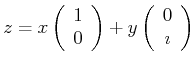
defined as the space of numbers spanned by the vectors:
, the complex numbers can be
defined as the space of numbers spanned by the vectors:
so that any complex number can be written as
 |
(08-2) |
 |
(08-3) |
 and
and  are real numbers.
Re
are real numbers.
Re and
Im
and
Im .
.
MATHEMATICA Example
 |
| (notebook Lecture-08) |
| (html Lecture-08) |
| (xml+mathml Lecture-08) |
|
Operations on complex numbers
|
Because the complex basis can be written in terms of the
vectors in Equation 8-1, it is natural
to plot complex numbers in two dimensions--typically these
two dimensions are the ``complex plane'' with
 associated
with the
-axis and
associated
with the
-axis and  associated with the
-axis.
associated with the
-axis.
The reflection of a complex number across the real axis is a useful operation. The image of a reflection across the real axis has some useful qualities and is given a special name--``the complex conjugate.''


|
 and
and 
 in the
complex plane:
The complex conjugate (
in the
complex plane:
The complex conjugate ( ) is a reflection across the real
axis; the minus (
) is a reflection across the real
axis; the minus ( ) operation is an inversion through
the origin; therefore
) operation is an inversion through
the origin; therefore
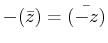 is equivalent
to either a reflection across the imaginary axis or an inversion
followed by a reflection across the real axis.
is equivalent
to either a reflection across the imaginary axis or an inversion
followed by a reflection across the real axis.
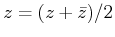 .
The imaginary part is the displacement projected onto the imaginary
axis, or the complex average of the complex number and
its reflection across the imaginary axis:
Im
.
The imaginary part is the displacement projected onto the imaginary
axis, or the complex average of the complex number and
its reflection across the imaginary axis:
Im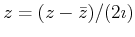 .
.