... ignored.1
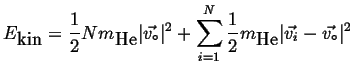
Questions about whether to include kinetic energy in the internal energy of a body can lead to considerable confusion in classical thermodynamics. One can choose to add the total kinetic energy of body to the total internal energy and keep track of the relative reference frames of the body and the observer. However, it is quite reasonable to ask ``Should one add the kinetic energies of all the individual particles that make up a body?'' To be specific, consider a balloon filled with Helium that is floating upwards at constant velocity \bgroup\color{blue}$ \vec{v_\circ}$\egroup. Suppose that, at some particular moment, each of the Helium atoms has a velocity \bgroup\color{blue}$ \vec{v_i}$\egroup. A reasonable way to divide up the kinetic energy of the \bgroup\color{blue}$ N$\egroup He atoms would be:

$\displaystyle E_{\mbox{kin}} = \ensuremath{\frac{1}{2}}N m_{\mbox{He}} \vert\ve...
...{N}}\ensuremath{\frac{1}{2}}m_{\mbox{He}} \vert\vec{v_i} - \vec{v_\circ}\vert^2$ (06-2)

where the last term includes all the velocities which taken together have zero average velocity. The first term has and old scholarly latin phrase associated with it--the vis viva kinetic energy. The kinetic energy associated with the summation is not ``readily observable'' by experiment and is associated with the internal energy \bgroup\color{blue}$ U$\egroup. For an ideal gas, all of the internal energy is associated with the sum.
.
.
.
.
.
.
.
.
.
.
.
.
.
.
.
.
.
.
.

.
.
.
.
.
.
.
.
.
.
.
... system.2
An excellent example of an application in which the gravitational term must be included is the calculation of partial pressure of Oxygen as a function of altitude.
.
.
.
.
.
.
.
.
.
.
.
.
.
.
.
.
.
.
.
.
.
.
.
.
.
.
.
.
.
.
... vacuum.3
In SI units, the permittivity of free space is approximately \bgroup\color{blue}$ {8.85410} \times 10^{-12}$\egroup F/m (F/m = m kg/( s\bgroup\color{blue}$ ^2$\egroup   coulomb\bgroup\color{blue}$ ^2$\egroup))
.
.
.
.
.
.
.
.
.
.
.
.
.
.
.
.
.
.
.
.
.
.
.
.
.
.
.
.
.
.
....4
We will discuss anisotropic properties later. An anisotropic material is one that does not satisfy the definition for isotropy.
.
.
.
.
.
.
.
.
.
.
.
.
.
.
.
.
.
.
.
.
.
.
.
.
.
.
.
.
.
.
... field.5
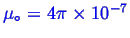
In SI (MKS) units, \bgroup\color{blue}$ \ensuremath{{\mu}_\circ} = \ensuremath{{4 \pi} \times 10^{-7}}$\egroup   newtons\bgroup\color{blue}$ /($\egroupampere\bgroup\color{blue}$ )^2$\egroup.
.
.
.
.
.
.
.
.
.
.
.
.
.
.
.
.
.
.
.
.
.
.
.
.
.
.
.
.
.
.