


In physics, you are used to dividing energy into two (or more) parts:
 |
(06-1) |
Typically, in thermodynamics, the body remain in the same inertial frame as the observer, so the velocity and rotation of the body can be taken to be zero. The kinetic energy of the system is typically ignored.1
It is useful, but not necessary, to divide the potential energy into parts that do not depend on its position in space and those that do, for instance:
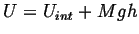 |
(06-3) |
In the majority of cases in materials thermodynamics, changes in the
potential energy due to gravity are not considered. If they are
required to account for the balance of internal energy, then they
must be included and terms like
 become a degree of freedom
for the system.2We will not consider gravitational energy any further and what
we mean by the internal energy
become a degree of freedom
for the system.2We will not consider gravitational energy any further and what
we mean by the internal energy
 will be intrinsic to the material system under consideration.
In other words, the internal energy of a body is associated with all the internal degrees of freedom of a body.