


How can the internal energy of a body be increased?
How can the internal energy of a body be decreased?
We consider all possible internal changes to the body as
making up the total internal energy
 . There are
two ways to change the internal energy:
those that involve work, and everything else.
. There are
two ways to change the internal energy:
those that involve work, and everything else.
Everything else is defined as heat. Heat is the defined as the transfer of energy to a body that does not involve work--or those transfers of energy that occur only because of a difference in temperature. As the Bellman would say, ``Repetition being the apotheoses of pedagogy''--therefore, heat is the workless transfer of energy.
So, by definition and as indefatigably observed by Joule:
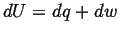 |
(06-4) |
Note: You will see this written up to four different
ways:
 ,
,
 ,
,
 , and
, and
 .
They are all correct!
They only differ in the definitions of the heat and work.
If there is a minus sign in front of
the
.
They are all correct!
They only differ in the definitions of the heat and work.
If there is a minus sign in front of
the
 , then
is the heat out of
the body; if a minus sign is in front of
, then
is the heat out of
the body; if a minus sign is in front of
 , it is
the work one by the body.
One consequence is that the student has to either pay
close attention to the definition that are being used
or use common sense--adding heat to a body should increase
its internal energy!
, it is
the work one by the body.
One consequence is that the student has to either pay
close attention to the definition that are being used
or use common sense--adding heat to a body should increase
its internal energy!
The flow of heat is fairly obvious; we can always refer to the changes due to a difference in temperatures of an object that has no work performed on it and the agent that is performing the work.
However, it is instructive to list the various ways that one can do work on a body--in other words, the ways that a body can store energy internally when you do work on the body.