


Next: Models for magnetic materials
Up: Lecture_06_web
Previous: Work of Polarization
The magnetic work has a form that is very similar to that of the polarization work.
However, there are important differences between magnetic properties.
One of the most important is that the linear material that relates the
induced magnetization to the applied field (by analogy to Eq. 6-7)
can be either positive or negative.
Physically, it is imagined that the material is composed of magnetic moments that
align (or anti-align) in response to an applied field.
There are two categories of magnetism:
- Ferromagnets
- Materials that can maintain a magnetization even when no there is no
applied magnetic field.
These are the magnets you find in toy stores, electric motors, and on
refrigerators.
Very few materials exhibit ferromagnetism; if they do it is likely that
they contain iron, cobalt, or nickel.
Ferromagnets tend to align their own magnetic field with an applied field--this
is the magic trick that allowed them to be discovered by the Chinese about 1000 years
ago and Europeans about 500 years ago.
- Non-Ferromagnets
- Non-ferromagnets do not sustain their own magnetic field when an applied field
is removed.
There are two important sub-categories of such non-permanent magnetic behavior:
- Paramagnetism
- The induced magnetic field in the material tends to align parallel with an applied
field.
- Diamagnetism
- The induced magnetic field in the material tends to align at right angles with an applied
field.
The relation between the applied field
 , the induced magnetic field
density
, the induced magnetic field
density
 and the total magnetic field density is analogous to
the case of the electric field (c.f. Eq.. 6-5):
and the total magnetic field density is analogous to
the case of the electric field (c.f. Eq.. 6-5):
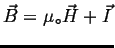 |
(06-11) |
is the applied magnetic field,
 is called the permeability of
vacuum and relates the magnetization of empty space to the applied field.5
is the magnetization of the material, it is the magnetic moment per unit volume
(a derived intensive quantity).
is called the permeability of
vacuum and relates the magnetization of empty space to the applied field.5
is the magnetization of the material, it is the magnetic moment per unit volume
(a derived intensive quantity).
 is the magnetic induction of the local net field density.
Exactly similar to the polarization work, the magnetic thermodynamic work is:
 |
(06-12) |
Next: Models for magnetic materials
Up: Lecture_06_web
Previous: Work of Polarization
W. Craig Carter
2002-09-13