


 |
For electric work due to polarizing a material:
 |
(06-5) |
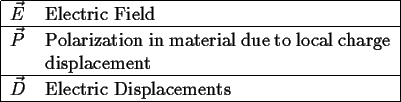
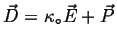
The electric displacement,
 , is the total polarization per unit volume.
The electric displacement is the sum of two terms: the electric field in
free space and the contribution due to the polarization of the material.
The electric displacement
can be thought of as the net polarization.
, is the total polarization per unit volume.
The electric displacement is the sum of two terms: the electric field in
free space and the contribution due to the polarization of the material.
The electric displacement
can be thought of as the net polarization.
 is the permittivity of free space; it is a conversion
between the units of electric field and polarization and its value reflects
how an electromagnetic wave travels through the vacuum.3
is the permittivity of free space; it is a conversion
between the units of electric field and polarization and its value reflects
how an electromagnetic wave travels through the vacuum.3
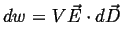
The polarization work done is:
 |
(06-6) |
Linear Isotropic Material Properties
The simplest model for polarizable material
is that the induced polarization density
 is linearly related to the
applied field
is linearly related to the
applied field
 :
:
 |
(06-7) |
 is
the dielectric susceptibility.
is a measure of the extend
to which a material to form internal dipoles.
is
the dielectric susceptibility.
is a measure of the extend
to which a material to form internal dipoles.
An isotropic material is one that the response of a material does not
depend on the direction of the applied field with
respect to the orientation of the crystal--that is the polarization direction
is parallel to the applied field
.4
In an isotropic material, then, the polarization of the material is in the same direction as the direction of electric field that is trying to polarize it:
 |
(06-8) |
 |
(06-9) |
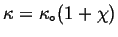
 is called the permittivity of a material.
If
does not depend on
and the material
generates no heat as it is polarized, then
 |
(06-10) |