Link to Current (updated) notes

next previous Next: Linearization of Systems of ODEs Up: Lecture_24_web Previous: Systems of Ordinary Differential Equations
Reduction of Higher Order ODEs to a System of First Order ODEs

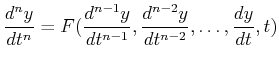
Higher-order ordinary differential equations can usually be re-written as a system of first-order differential equations. If the higher-order ODE can be solved for its largest derivative:

$\displaystyle \ensuremath{\frac{d^{n}{y}}{d{t}^{n}}} = F(\ensuremath{\frac{d^{n...
...ath{\frac{d^{n-2}{y}}{d{t}^{n-2}}}, \ldots , \ensuremath{\frac{d{y}}{d{t}}}, t)$ (24-6)

then $ n-1$ ``new'' functions can be introduced via
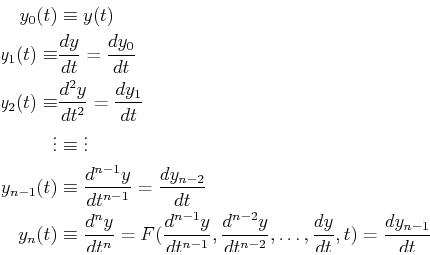
\begin{displaymath}\begin{split}y_0(t) & \equiv y(t)\ y_1(t) \equiv & \ensurema...
...d{t}}}, t) = \ensuremath{\frac{d{y_{n-1}}}{d{t}}}\ \end{split}\end{displaymath} (24-7)

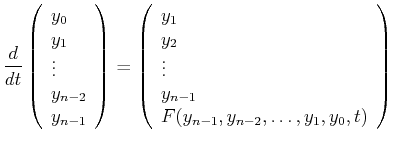
or

$\displaystyle \ensuremath{\frac{d{}}{d{t}}} \left( \begin{array}{l} y_0\ y_1\\...
...ots\ y_{n-1}\ F(y_{n-1}, y_{n-2}, \ldots , y_1, y_0, t)\ \end{array} \right)$ (24-8)

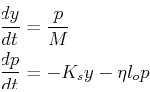
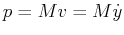
For example, the damped harmonic oscillator, $ M \ddot{y} + \eta l_o \dot{y} + K_s y = 0$ , can be re-written by introducing the momentum variable, $ p = M v = M \dot{y}$ , as the system:

\begin{displaymath}\begin{split}\ensuremath{\frac{d{y}}{d{t}}} & = \frac{p}{M}\\...
...remath{\frac{d{p}}{d{t}}} & = -K_s y - \eta l_o p\ \end{split}\end{displaymath} (24-9)

which has only one critical point $ y=p=0$ .

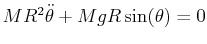
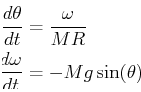
The equation for a free pendulum, $ M R^2 \ddot{\theta} + M g R \sin(\theta) = 0$ , can be re-written by introducing the angular momentum variable, $ \omega = M R \dot{\theta}$ as the system,

\begin{displaymath}\begin{split}\ensuremath{\frac{d{\theta}}{d{t}}} &= \frac{\om...
...th{\frac{d{\omega}}{d{t}}} &= - M g \sin(\theta) \ \end{split}\end{displaymath} (24-10)

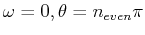
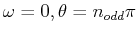
which has two different kinds of critical points: ( $ \omega = 0, \theta = n_{even} \pi$ ) and ( $ \omega = 0, \theta = n_{odd} \pi$ ).

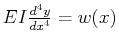
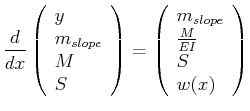
Finally, the beam equation $ EI \ensuremath{\frac{d^{4}{y}}{d{x}^{4}}} = w(x)$ can be rewritten as the system:

$\displaystyle \ensuremath{\frac{d{}}{d{x}}} \left( \begin{array}{l} y\ m_{slop...
...\left( \begin{array}{l} m_{slope}\ \frac{M}{EI}\ S\ w(x) \end{array} \right)$ (24-11)

where $ m_{slope}$ is the slope of the beam, $ M$ is the local bending moment in the beam, $ S$ is the local shearing force in the beam, and $ w(x)$ is the load density.

This beam equation does not have any interesting critical points.


© W. Craig Carter 2003-, Massachusetts Institute of Technology