Next: Index
Up: Lecture_24_web
Previous: Reduction of Higher Order ODEs to a System
Next: Index
Up: Lecture_24_web
Previous: Reduction of Higher Order ODEs to a System
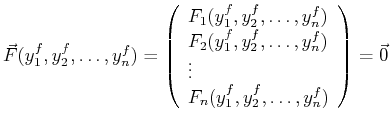
The critical point plays a very important role in understanding the behavior of non-linear ODEs.
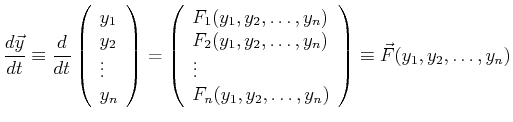
The general autonomous non-linear ODE can be written as:
 |
(24-12) |
 |
(24-13) |
 be
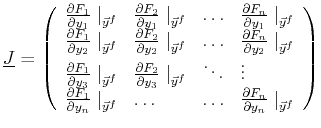
a point near a fixed point, then a linear
approximation is:
be
a point near a fixed point, then a linear
approximation is:
 |
(24-16) |
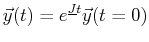
Rather than solve the matrix equation directly, it makes more
sense to transform the system into one that is diagonalized.
In other words, instead of solving
Eq. 24-14 with
Eq. 24-15 near the fixed point,
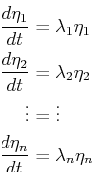
find the eigenvalues,  , of Eq. 24-15 and
solve the simpler system by transforming the
, of Eq. 24-15 and
solve the simpler system by transforming the
 into
the eigenframe
into
the eigenframe
 :
:
 |
(24-17) |
 |
(24-18) |
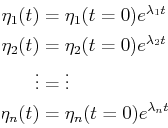
If any of the eigenvalues of  are positive, then
an initial condition near that fixed point will diverge from
that point--stability occurs only if all the eigenvalues are
negative.
are positive, then
an initial condition near that fixed point will diverge from
that point--stability occurs only if all the eigenvalues are
negative.
MATHEMATICA Example
 |
| (notebook Lecture-24) |
| (html Lecture-24) |
| (xml+mathml Lecture-24) |
| Analyzing Stability for the Predator-Prey Problem
|