
 Next: Harmonic Oscillators
Up: Lecture_22_web
Previous: Lecture_22_web
Next: Harmonic Oscillators
Up: Lecture_22_web
Previous: Lecture_22_web
This idea can be generalized to operators that take a function as an argument and return another function.
The derivative operator operates on a function and returns another function that describes how the function changes:
![\begin{displaymath}\begin{split}\mathcal{D}[f(x)] & = \ensuremath{\frac{d{f}}{d{...
...)]\\ \mathcal{D}[f(x) + g(x)] = & D[f(x)] + D[g(x)] \end{split}\end{displaymath}](img1.png) |
(22-1) |
The integration operator is the right-inverse of

![$\displaystyle \mathcal{D} [\mathcal{I}[ f(x)]] = \mathcal{D}[ \int f(x) dx]$](img3.png) |
(22-2) |
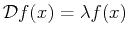
Consider the differential operator that returns a constant multiplied by itself
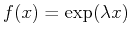 , can be
considered an eigenfunction of
Eq. 22-3.
, can be
considered an eigenfunction of
Eq. 22-3.
For the homogeneous second-order equation,
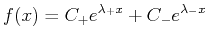 |
(22-5) |
Operators can be used algebraically, consider the inhomogeneous second-order ODE
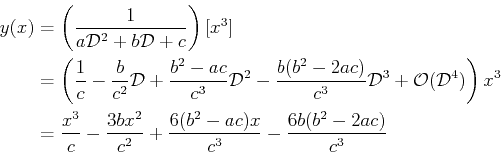 |
(22-7) |
The Fourier transform is also a linear operator:
![\begin{displaymath}\begin{split}\mathcal{F}[f(x)] =& g(k) = \frac{1}{\sqrt{2 \pi...
...i}} \int_{-\infty}^{\infty} g(k) e^{-\imath k x} dk \end{split}\end{displaymath}](img10.png) |
(22-8) |
Combining operators is another useful way to solve differential equations.
Consider the Fourier transform,
 , operating on the
differential operator,
, operating on the
differential operator,
 :
:
![$\displaystyle \mathcal{F}[\mathcal{D}[f]] = \frac{1}{\sqrt{2 \pi}} \int_{-\infty}^{\infty} \ensuremath{\frac{d{f(x)}}{d{x}}} e^{i k x} dx$](img13.png) |
(22-9) |
 |
(22-10) |
 exists, then typically2
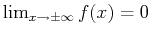 .
In this case,
.
In this case,
![$\displaystyle \mathcal{F}[\mathcal{D}[f]] = -i k \mathcal{F}[f(x)]$](img19.png) |
(22-11) |
Consider the heterogeneous second-order linear ODE which represent a forced, damped, harmonic oscillator that will be discussed later in this lecture.
 ) domain to
a frequency (
) domain to
a frequency ( ) domain) to both sides of 22-13:
 .
.
Equation 22-14 can be solved for the Fourier transform:
 that has a Fourier transform equal the
the right-hand-side of Eq. 22-15-or, equivalently,
operating with the inverse Fourier transform on the
right-hand-side of Eq. 22-15.
that has a Fourier transform equal the
the right-hand-side of Eq. 22-15-or, equivalently,
operating with the inverse Fourier transform on the
right-hand-side of Eq. 22-15.
MATHEMATICA Example
 |
| (notebook Lecture-22) |
| (html Lecture-22) |
| (xml+mathml Lecture-22) |
| Operator Calculus and the Solution to the Damped-Forces Harmonic
Oscillator Model
MATHEMATICA
|
Equally powerful is the concept of a functional which
takes a function as an argument and returns a value.
For example
![$ \mathcal{S}[y(x)]$](img31.png) , defined below, operates on
a function
, defined below, operates on
a function  and returns its surface of revolution's area
for
and returns its surface of revolution's area
for  :
:
![$\displaystyle \mathcal{S}[y(x)] = 2 \pi \int_0^L y \sqrt{1 + \left(\ensuremath{\frac{d{y}}{d{x}}}\right)^2} dx$](img34.png) |
(22-16) |
 to
to  ,
which is the
,
which is the  that has the smallest surface area?''
This idea of finding ``which function maximizes or minimizes something'' can be very powerful and practical.
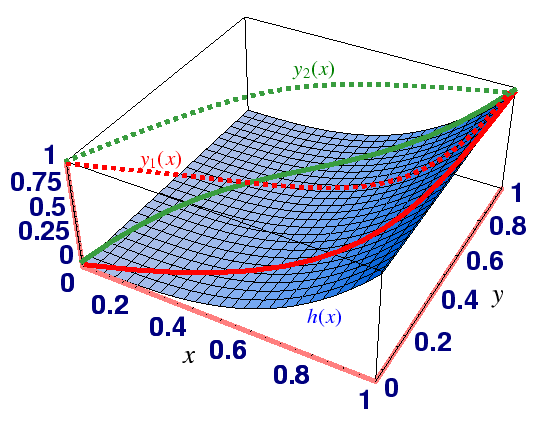
Suppose you are asked to run an ``up-hill'' race from some starting
point 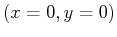 to some ending point
 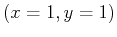 and there
is a ridge
and there
is a ridge
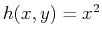 .
What is the most efficient running route
.
What is the most efficient running route  ?3
?3

|
A reasonable model for running speed as a function of climbing-angle  is
is
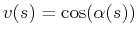 |
(22-17) |
 is the arclength along the path.
The maximum speed occurs on flat ground
is the arclength along the path.
The maximum speed occurs on flat ground  and running
speed monotonically falls to zero as
and running
speed monotonically falls to zero as
 .
To calculate the time required to traverse any path
.
To calculate the time required to traverse any path  with endpoints
 and
and  ,
,
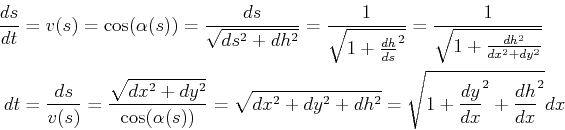 |
(22-18) |
 , the time as a functional of the
path is:
, the time as a functional of the
path is:
MATHEMATICA Example
 |
| (notebook Lecture-22) |
| (html Lecture-22) |
| (xml+mathml Lecture-22) |
| Functionals: Introduction to Variational Calculus by Variation of Parameters
|
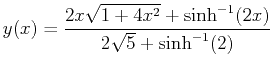
There is a powerful and beautiful mathematical method for finding the extremal functions of functionals which is called Calculus of Variations.
By using the calculus of variations, the optimal path  for
Eq. 22-19 can be determined:
for
Eq. 22-19 can be determined:
 |
(22-20) |
The approximation determined in the
MATHEMATICA example above is
pretty good.
example above is
pretty good.
![$\displaystyle \left(\mathcal{D}^2 + \beta \mathcal{D} - \gamma \right)[ f(x)] = 0$](img6.png)
![$\displaystyle \left(a \mathcal{D}^2 + b \mathcal{D} + c\right)[y(x)] = x^3$](img8.png)
![\begin{displaymath}\begin{split}\mathcal{F}[\mathcal{D}^2[f]] & = -k^2 \mathcal{...
...{D}^n[f]] & = (-1)^n \imath^n k^n \mathcal{F}[f(x)] \end{split}\end{displaymath}](img20.png)

![\begin{displaymath}\begin{split}\mathcal{F}[M \ensuremath{\frac{d^2{y(t)}}{d{t}^...
...ta(\omega-\omega_o) +\delta(\omega+\omega_o)\right] \end{split}\end{displaymath}](img24.png)
![$\displaystyle \mathcal{F}[y] = \sqrt{\frac{-\pi}{2}} \frac{ \left[ \delta(\omeg...
...ega_o) +\delta(\omega+\omega_o)\right] } { M \omega^2 + \imath \omega V - K_s }$](img26.png)
 does have built-in functions to take Fourier (and other kinds of)
integral transforms.
However, as will be seen below, using operational calculus to
solve ODEs is not necessarily simple in
MATHEMATICA
does have built-in functions to take Fourier (and other kinds of)
integral transforms.
However, as will be seen below, using operational calculus to
solve ODEs is not necessarily simple in
MATHEMATICA .
Nevertheless, it may be instructive to force it--if only as an
an example of using the good tool for the wrong purpose.
.
Nevertheless, it may be instructive to force it--if only as an
an example of using the good tool for the wrong purpose.
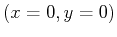 and ending point
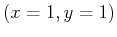 .
Assuming a model for how much running speed slows with the
steepness of the path--which route would be quicker, one (
.
Assuming a model for how much running speed slows with the
steepness of the path--which route would be quicker, one ( )
that starts going up-hill at first or another (
)
that starts going up-hill at first or another ( ) that initially
traverses a lot of ground quickly?
) that initially
traverses a lot of ground quickly?![$\displaystyle \mathcal{T}[y(x)] = \int_0^1 \sqrt{1 + {\ensuremath{\frac{d{y}}{d{x}}}}^2 + 4 x^2} \; dx$](img61.png)
 (if such a
function exists) that minimizes the function in Eq.
(if such a
function exists) that minimizes the function in Eq. 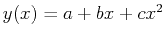 as an ``approximating function''
and then find the parameters
as an ``approximating function''
and then find the parameters  ,
,  , and
, and  , that minimize the functional.
 in Eq.
  to integrate without limits in
Eq.
to integrate without limits in
Eq.