
 Next: Fourth Order ODEs, Elastic Beams
Up: Lecture_21_web
Previous: Second Order ODEs with Constant Coefficients
Next: Fourth Order ODEs, Elastic Beams
Up: Lecture_21_web
Previous: Second Order ODEs with Constant Coefficients
It has been shown that all solutions to
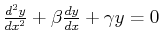 can be determined from a linear combination of
the basis solution.
Disregard for a moment whether the solution is complex
or real, and ignoring the special case
can be determined from a linear combination of
the basis solution.
Disregard for a moment whether the solution is complex
or real, and ignoring the special case
 .
The solution to any problem is given by
.
The solution to any problem is given by
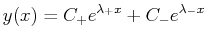 |
(21-14) |
 and
and  can be obtained.
In many physical problems, these two conditions appear at the boundary of the domain. A typical problem is posed like this:
Solve
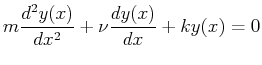 on on  |
(21-15) |
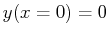 and
and 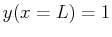
or, solve
on  |
(21-16) |
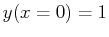 and
and 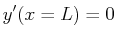
When the value of the function is specified at a point, these are called Dirichlet conditions; when the derivative is specified, the boundary condition is called a Neumann condition. It is possible have boundary conditions that are mixtures of Dirichlet and Neumann.
MATHEMATICA Example
 |
| (notebook Lecture-21) |
| (html Lecture-21) |
| (xml+mathml Lecture-21) |
| Determining Solution Constants from Boundary Values
When the domain is infinite or semi-infinite and the physical situation indicates that the solution must be bounded, then one can automatically set the constants associated with roots with real positive parts to zero, because these solutions grow without bound. |
 and
and  .
.
 and
and  .
.