
 Next: Boundary Value Problems
Up: Lecture_21_web
Previous: Higher-Order Equations: Background
Next: Boundary Value Problems
Up: Lecture_21_web
Previous: Higher-Order Equations: Background
The most simple case--but one that results from models of many physical phenomena--is that functions in the homogeneous second-order linear ODE (Eq. 21-5) are constants:
If two independent solutions can be obtained, then any solution can be formed from this basis pair.
Surmising solutions seems a sensible strategy, certainly
for shrewd solution seekers.
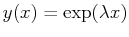
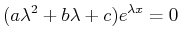
Suppose the solution is of the form
 and
put it into
Eq. 21-9:
and
put it into
Eq. 21-9:
 |
(21-10) |
 has solutions for
  .
.
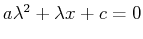
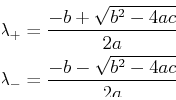
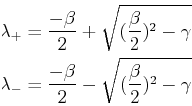
Because two solutions are needed and because the quadratic equation yields two solutions:
 |
(21-11) |
 :
:
 |
(21-12) |
 and
and
 .
.
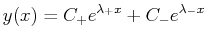
Therefore, any solution to Eq. 21-9 can be written as
 |
(21-13) |
MATHEMATICA Example
 |
| (notebook Lecture-21) |
| (html Lecture-21) |
| (xml+mathml Lecture-21) |
Solutions to
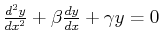
Because the fundamental solution depend on only two parameters
|
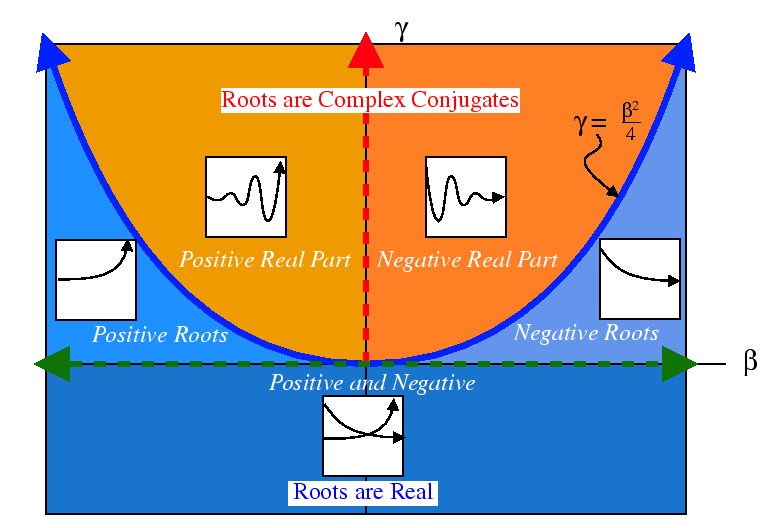
The behavior of all solutions can be collected into a simple picture:

|
The case that separates the complex solutions from the real solutions,
 must be treated separately, for
the case
it can be shown that
must be treated separately, for
the case
it can be shown that
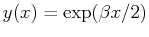 and
and
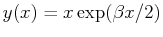 form an independent basis pair
(see Kreyszig AEM, p. 74).
form an independent basis pair
(see Kreyszig AEM, p. 74).
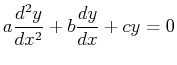
 and
and
 , the behavior of all solutions can be visualized in the
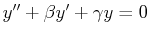 and solve for a condition on
  )
)
 ) or shrinking (
 ) solutions
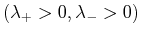 --monotonically growing solutions,
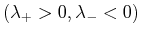 --one growing and one decaying solution,
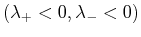 --monotonically decaying solutions.