Next: Second Order ODEs with Constant Coefficients
Up: Lecture_21_web
Previous: Lecture_21_web
Next: Second Order ODEs with Constant Coefficients
Up: Lecture_21_web
Previous: Lecture_21_web
For first-order ordinary differential equations (ODEs),
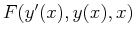 ,
one value
,
one value  was needed to specify a particular solution.
For second-order equations, two independent values are needed.
This is illustrated in the following forward-differencing example.
was needed to specify a particular solution.
For second-order equations, two independent values are needed.
This is illustrated in the following forward-differencing example.
MATHEMATICA Example
 |
| (notebook Lecture-21) |
| (html Lecture-21) |
| (xml+mathml Lecture-21) |
| A Second-Order Forward Differencing Example
Recall the example in Lecture 19 of a first-order differencing scheme: at each iteration the function grew proportionally to its current size. In the limit of very small forward differences, the scheme converged to exponential growth. Now consider a situation in which function's current rate of growth increases proportionally to two terms: its current rate of growth and its size.
Change in Value's Rate of Change  (the Value) (the Value) (Value's Rate of Change) (Value's Rate of Change)
To Calculate a forward differencing scheme for this case, let

and then solve for the ``next increment''  if
if
 and
and
 are known.
|
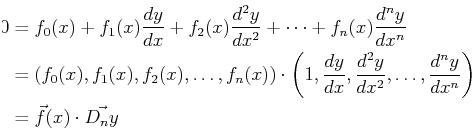
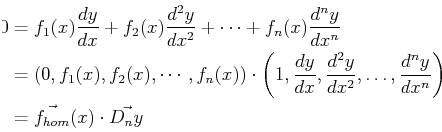
Therefore, a linear heterogeneous ordinary differential equation
can be written as a product of general functions of the
dependent variable and the derivatives for the  -order linear
case:
-order linear
case:
 -order linear ordinary differential equation is
defined by
-order linear ordinary differential equation is
defined by  in Eq. 21-1:
 |
(21-2) |
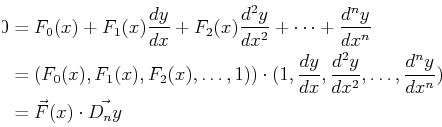
Equation 21-1 can always be multiplied by
 to generate the general form:
 |
(21-3) |
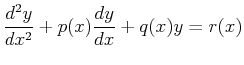
For the second-order linear ODE, the heterogeneous form can always be written as:
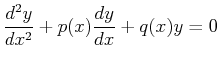
Because two values must be specified for each solution to a second order equation--the solution can be broken into two basic parts, each deriving from a different constant. These two independent solutions form a basis pair for any other solution to the homogeneous second-order linear ODE that derives from any other pair of specified values.
The idea is the following:
suppose the solution to Eq. 21-5
is found the particular case of specified parameters
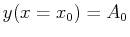 and
and
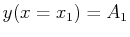 , the solution
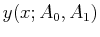 can be written
as the sum of solutions to two other problems.
can be written
as the sum of solutions to two other problems.
 |
(21-6) |
 |
(21-7) |
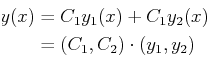
The two arbitrary integration constants can be included in the definition of the general solution:
 |
(21-8) |
 be the forward-differencing increment.