
 Next: Separable Equations
Up: Lecture_19_web
Previous: Differential Equations: Introduction
Next: Separable Equations
Up: Lecture_19_web
Previous: Differential Equations: Introduction
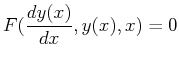
The relationship between a function and its derivatives for a first-order ODE,
 |
(19-4) |
 .
The surface specifies a relationship that must be satisfied between
the three coordinates.
.
The surface specifies a relationship that must be satisfied between
the three coordinates.
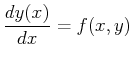
If  can be solved for exactly,
 |
(19-5) |
can be thought of as a height above the  -
- plane.
MATHEMATICA Example
 |
| (notebook Lecture-19) |
| (html Lecture-19) |
| (xml+mathml Lecture-19) |
| The Geometry of First-Order ODES: Examples
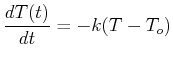
Consider Newton's law of cooling that states that the rate that a body cools by radiation is proportional to the difference in temperature between the body and its surroundings:
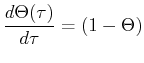
Make the equation simpler by converting to a non-dimensional form, let  and
and
 , then
|