
 Next: Geometrical Interpretation of Solutions
Up: Lecture_19_web
Previous: Lecture_19_web
Next: Geometrical Interpretation of Solutions
Up: Lecture_19_web
Previous: Lecture_19_web
Ordinary differential equations are relations between a function of a single variable, its derivatives, and the variable:
 |
(19-1) |
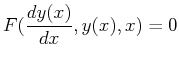 |
(19-2) |
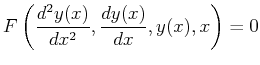 |
(19-3) |
For example, the one-dimensional time-independent Shrödinger equation,
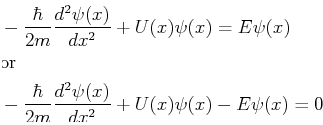
is a second-order ordinary differential equation that specifies a relation between the wave function,
 , its derivatives, and a spatially dependent
function
, its derivatives, and a spatially dependent
function  .
.
Differential equations result from physical models of anything that varies--whether in space, in time, in value, in cost, in color, etc. For example, differential equations exist for modeling quantities such as: volume, pressure, temperature, density, composition, charge density, magnetization, fracture strength, dislocation density, chemical potential, ionic concentration, refractive index, entropy, stress, etc. That is, almost all models for physical quantities are formulated with a differential equation.
The following example illustrates how some first-order equations arise:
MATHEMATICA Example
 |
| (notebook Lecture-19) |
| (html Lecture-19) |
| (xml+mathml Lecture-19) |
| Iteration: First-Order Sequences
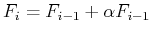
Consider a function that changes according to its current size-that is, at a subsequent iteration, the function grows or shrinks according to how large it is currently.
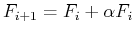
which is equivalent to
|
|
MATHEMATICA
Example |
| (notebook Lecture-19) |
| (html Lecture-19) |
| (xml+mathml Lecture-19) |
| First-Order Finite Differences
The example above is not terribly useful because the change
at each increment is an integer and the function only has
values for integers.
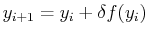
To generalize, a forward difference can be added that
allows the variable of the function to ``go forward''
at an arbitrarily small increment,
If the rate of change of
or where  plays the role of an `indexed grid' with small separations
 .
.
|
|
MATHEMATICA
Example |
| (notebook Lecture-19) |
| (html Lecture-19) |
| (xml+mathml Lecture-19) |
| First-Order Operators
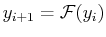
The forward-difference equation considered above
relates the next iteration,
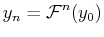
In this way, the  iteration is determined from
the initial value with
iteration is determined from
the initial value with
|
 , is a function
  of the current value, then,

 to the current value
  .
Only
.
Only