
 Next: Index
Up: Lecture_19_web
Previous: Geometrical Interpretation of Solutions
Next: Index
Up: Lecture_19_web
Previous: Geometrical Interpretation of Solutions
If a first-order ordinary
differential equation
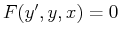 can be rearranged so that
only one variable, for instance
can be rearranged so that
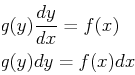
only one variable, for instance  , appears on the left-hand-side multiplying
its derivative and
the other,
, appears on the left-hand-side multiplying
its derivative and
the other,  , appears only on the right-hand-side, then the
equation is said to be `separated.''
, appears only on the right-hand-side, then the
equation is said to be `separated.''
 |
(19-6) |
 |
(19-7) |
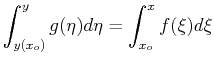
 is known.
If not, the equation can
be solved with an integration constant
is known.
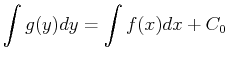
If not, the equation can
be solved with an integration constant  ,
,
 |
(19-8) |
is determined from initial conditions.
MATHEMATICA Example
 |
| (notebook Lecture-19) |
| (html Lecture-19) |
| (xml+mathml Lecture-19) |
| Using
MATHEMATICA
's Built-in Ordinary Differential Equation Solver
MATHEMATICA |
While the accuracy of the first-order differencing scheme can
be determined by comparison to an exact solution, the question
remains of how to establish accuracy and convergence
with the step-size  for an arbitrary ODE.
This is a question of primary importance and studied by
Numerical Analysis.
for an arbitrary ODE.
This is a question of primary importance and studied by
Numerical Analysis.