Next: Index
Up: Lecture_17_web
Previous: Other forms of the Fourier coefficients
Next: Index
Up: Lecture_17_web
Previous: Other forms of the Fourier coefficients
The behavior of the Fourier coefficients for both the
odd (sine) and for the even (cosine) terms was illustrated
above.
Functions that are even about the center of the fundamental domain
(reflection symmetry) will have only even terms--all the sine
terms will vanish.
Functions that are odd about the center of the fundamental domain
(reflections across the center of the domain and then
across the  -axis.) will have only odd terms--all the cosine
terms will vanish.
-axis.) will have only odd terms--all the cosine
terms will vanish.
Functions with no odd or even symmetry will have both types of terms (odd and even) in its expansion. This is a restatement of the fact that any function can be decomposed into odd and even parts (see Eq. 17-3).
This suggests a short-hand in Eq. 17-4 can be used
that combines both odd and even series into one single form.
However, because the odd terms will all be multiplied by
the imaginary number  , the coefficients will generally
be complex.
Also because
, the coefficients will generally
be complex.
Also because
 , writing the
sum in terms of exponential functions only will require that the
sum must be over both positive and negative integers.
, writing the
sum in terms of exponential functions only will require that the
sum must be over both positive and negative integers.
For a periodic domain
 ,
,
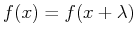 , the
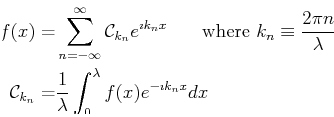
complex form of the fourier series is given by:
, the
complex form of the fourier series is given by:
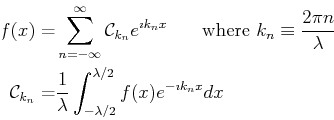
Because of the orthogonality of the basis functions
 ,
the domain can be moved to any wavelength, the following is also true:
,
the domain can be moved to any wavelength, the following is also true: