
 Next: Complex Form of the Fourier Series
Up: Lecture_17_web
Previous: Fourier Series
Next: Complex Form of the Fourier Series
Up: Lecture_17_web
Previous: Fourier Series
 as the starting point and
  as the period, and
in these cases the forms for the Fourier coefficients look a bit
different.
One needs to look at the domain in order to determine which form
of the formulas to use.
as the period, and
in these cases the forms for the Fourier coefficients look a bit
different.
One needs to look at the domain in order to determine which form
of the formulas to use.
| Extra Information and Notes
Potentially interesting but currently unnecessary |
|
The ``trick'' of multiplying both sides of Eq. 17-8
by a function and integrating comes from the fact that
the trigonometric functions form an orthogonal basis for
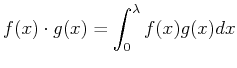
functions with inner product defined by
Considering the trigonometric functions as components of a vector:
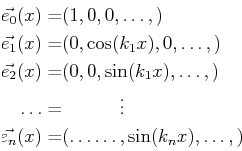
then these ``basis vectors'' satisfy 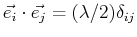 ,
where
,
where
 unless
  .
The trick is just that, for an arbitrary function represented
by the basis vectors,
.
The trick is just that, for an arbitrary function represented
by the basis vectors,
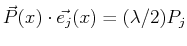 .
. |