
 Next: Other forms of the Fourier coefficients
Up: Lecture_17_web
Previous: Representing a particular function with a sum of
Next: Other forms of the Fourier coefficients
Up: Lecture_17_web
Previous: Representing a particular function with a sum of
The functions
 and
and
 each have period
  .
That is, they each take on the same value at
.
That is, they each take on the same value at  and
and
 .
.
There are an infinite number of other simple trigonometric functions
that are periodic in
; they are
![$ \cos[ 2 \pi x/(\lambda/2)) ]$](img36.png) and
and
![$ \sin[ 2 \pi x/(\lambda/2)) ]$](img37.png) and
which cycle two times
within each
,
and
which cycle two times
within each
,
![$ \cos[ 2 \pi x/(\lambda/3)) ]$](img38.png) and
and
![$ \sin[ 2 \pi x/(\lambda/3)) ]$](img39.png) and
which cycle three times
within each
, and, in general,
and
which cycle three times
within each
, and, in general,
![$ \cos[ 2 \pi x/(\lambda/n)) ]$](img40.png) and
and
![$ \sin[ 2 \pi x/(\lambda/n)) ]$](img41.png) and
which cycle
and
which cycle  times
within each
.
times
within each
.
The constant function,
 const
, also satisfies
the periodicity requirement.
const
, also satisfies
the periodicity requirement.
The superposition of multiples of any number of periodic function
must also be a periodic function, therefore any function  that
satisfies:
that
satisfies:
 are the wave-numbers or reciprocal wavelengths
defined by
are the wave-numbers or reciprocal wavelengths
defined by
 .
The
.
The  's represent inverse wavelengths--large values
of
represent short-period or high-frequency terms.
's represent inverse wavelengths--large values
of
represent short-period or high-frequency terms.
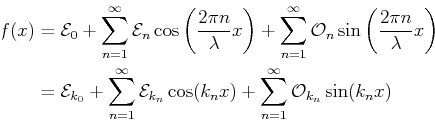
If any periodic function
could be represented by the series in
in Eq. 17-8 by a suitable choice of coefficients, then
an alternative representation of the periodic function could be
obtained in terms of the simple trigonometric functions and their
amplitudes.
The ``inverse question'' remains: ``How are the amplitudes
 (the even trigonometric terms) and
 (the odd trigonometric terms) determined
for a given
?''
(the odd trigonometric terms) determined
for a given
?''
The method follows from what appears to be a ``trick.''
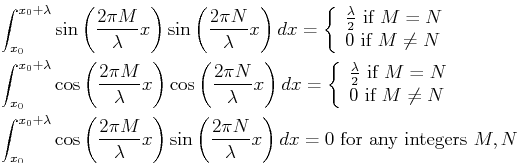
The following three integrals have simple forms for integers  and
and  :
:
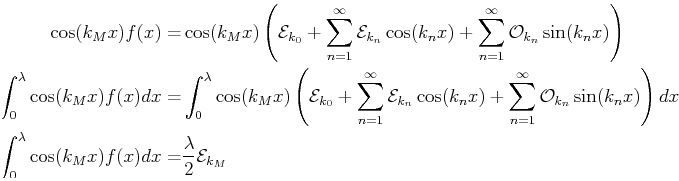
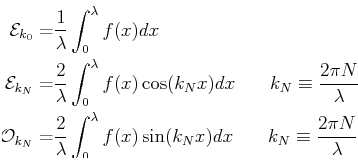
Therefore, any amplitude can be determined by multiplying both sides of
Eq. 17-8 by
its conjugate trigonometric function and integrating over the domain.
(Here we pick the domain to start at zero,
 ,
but any other starting point would work fine.)
,
but any other starting point would work fine.)
 |
(17-10) |
periodic in the
fundamental domain
.
The constant term has an extra factor of two because
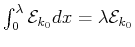 instead of the
  found in Eq. 17-9.
MATHEMATICA Example
 |
| (notebook Lecture-17) |
| (html Lecture-17) |
| (xml+mathml Lecture-17) |
| Orthogonality of Trignometric Functions
Demonstrate that the relations in Eq. 17-9 are true.
MATHEMATICA Calculating Fourier Amplitudes
would
have a package to do this and replace the inefficient functions
defined above.
|
 ,
with which to demonstrate the Fourier
approximation.
This function is even about the
,
with which to demonstrate the Fourier
approximation.
This function is even about the  point.
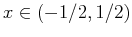
 is used for the domain, then we
should see that all odd (sine) Fourier amplitudes should vanish.
is used for the domain, then we
should see that all odd (sine) Fourier amplitudes should vanish.
 .
.