Next: Representing a particular function with a sum of
Up: Lecture_17_web
Previous: Periodic Functions
Next: Representing a particular function with a sum of
Up: Lecture_17_web
Previous: Periodic Functions
The trigonometric functions have the additional properties of
being an odd function about the point  :
:
 in the case of the sine,
and an even function in the case of the cosine:
in the case of the sine,
and an even function in the case of the cosine:
 .
.
This can generalized to say that a function is even or
odd about a point  :
:
 and
and
 .
.
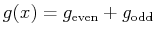
Any function can be decomposed into an odd and even sum:
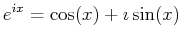
The sine and cosine functions can be considered the odd and even parts of the generalized trigonometric function:
 .
.