
 Next: Odd and Even Functions
Up: Lecture_17_web
Previous: Lecture_17_web
Next: Odd and Even Functions
Up: Lecture_17_web
Previous: Lecture_17_web
Periodic functions should be familiar to everyone. The keeping of time, the ebb and flow of tides, the patterns and textures of our buildings, decorations, and vestments invoke repetition and periodicity that seem to be inseparable from the elements of human cognition.1
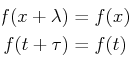
A function that is periodic in a single variable can be expressed as:
 |
(17-1) |
 and the second form suggests a function that is
periodic in time with period
and the second form suggests a function that is
periodic in time with period  .
Of course, both forms are identical and express that the function
has the same value at an infinite number of points (
.
Of course, both forms are identical and express that the function
has the same value at an infinite number of points (
 in
space or
in
space or
 in time where
  is an integer.)
Specification of a periodic function,  , within one period
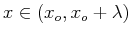 defines the function everywhere.
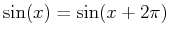
The most familiar periodic functions are the trigonometric functions:
defines the function everywhere.
The most familiar periodic functions are the trigonometric functions:
 and and 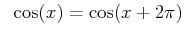 |
(17-2) |
MATHEMATICA Example
 |
| (notebook Lecture-17) |
| (html Lecture-17) |
| (xml+mathml Lecture-17) |
Making Periodic Functions
Periodic functions are often associated with the ``modulus'' operation.
Mod![$ [ x, \lambda ]$](img12.png) is the remainder of dividing
is the remainder of dividing  by
.
Its result always lies in the domain
by
.
Its result always lies in the domain
 Mod Mod![$ [x, \lambda] \leq \lambda)$](img15.png) .
Another way to think of modulus is to find the ``point'' where
are periodic function should be evaluated if its primary domain
is
.
Another way to think of modulus is to find the ``point'' where
are periodic function should be evaluated if its primary domain
is
 .
.
|