
 Next: Integration over Surfaces
Up: Lecture_15_web
Previous: Green's Theorem for Area in Plane Relating to
Next: Integration over Surfaces
Up: Lecture_15_web
Previous: Green's Theorem for Area in Plane Relating to
 in the form of
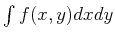 introduces
surface integration--over a planar surface--as a straightforward extension
to integration along a line.
Just as integration over a line was generalized to integration over a curve by
introducing two or three variables that depend on a single variable (e.g.,
introduces
surface integration--over a planar surface--as a straightforward extension
to integration along a line.
Just as integration over a line was generalized to integration over a curve by
introducing two or three variables that depend on a single variable (e.g.,
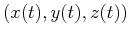 ), a surface integral can be conceived as introducing
three (or more) variables that depend on two parameters (i.e.,
), a surface integral can be conceived as introducing
three (or more) variables that depend on two parameters (i.e.,
 ).
).
However, there are different ways to formulate representations of surfaces:
MATHEMATICA Example
 |
| (notebook Lecture-15) |
| (html Lecture-15) |
| (xml+mathml Lecture-15) |
| Representations of Surfaces
|
Surfaces and interfaces play fundamental roles in materials science and engineering. Unfortunately, the mathematics of surfaces and interfaces frequently presents a hurdle to materials scientists and engineering. The concepts in surface analysis can be mastered with a little effort, but there is no escaping the fact that the algebra is tedious and the resulting equations are onerous. Symbolic algebra and numerical analysis of surface alleviates much of the burden.
Most of the practical concepts derive from a second-order Taylor expansion of a surface near a point. The first-order terms define a tangent plane; the tangent plane determines the surface normal. The second-order terms in the Taylor expansion form a matrix and a quadratic form that can be used to formulate an expression for curvature. The eigenvalues of the second-order matrix are of fundamental importance.
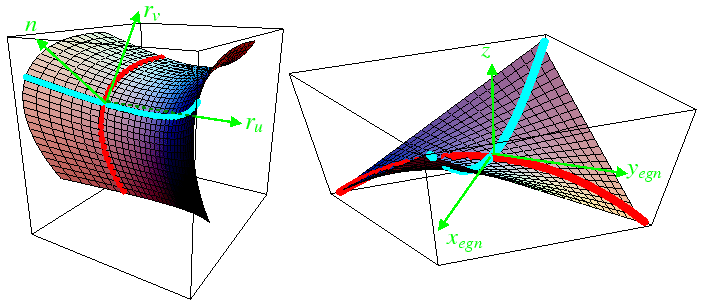
The Taylor expansion about a particular point on the surface
takes a particularly simple form if the origin of the coordinate system
is located at the point and the  -axis is taken along the surface normal
as illustrated in the following figure.
-axis is taken along the surface normal
as illustrated in the following figure.

|
In this coordinate system, the Taylor expansion of  must be of the form

If this coordinate system is rotated about the
-axis into its eigenframe
where the off-diagonal components vanish, then the two eigenvalues represent
the maximum and minimum curvatures.
The sum of the eigenvalues is invariant to transformations and the sum is
known as the mean curvature of the surface.
The product of the eigenvalues is also invariant--this quantity is known
as the Gaussian curvature.
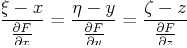
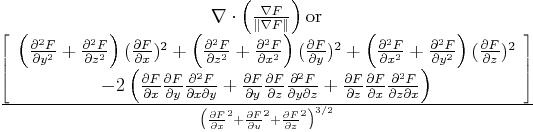
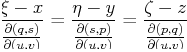
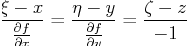
The method in the figure suggests a method to calculate the normals and curvatures for a surface. Those results are tabulated below.
| Level Set Surfaces: Tangent Plane, Surface Normal, and Curvature |
 |
Tangent Plane (
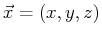 ,
,
 )
) |
 |
| Normal |
 |
| Mean Curvature |
 |
| Parametric Surfaces: Tangent Plane, Surface Normal, and Curvature |
 |
| Tangent Plane (
,
) |
 |
| Normal |
 |
| Mean Curvature |
 |
| Graph Surfaces: Tangent Plane, Surface Normal, and Curvature |
 |
| Tangent Plane (
,
) |
 |
| Normal |
 |
| Mean Curvature |
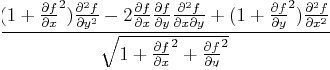 |
 coincides with
the
coincides with
the