Next: Index
Up: Lecture_15_web
Previous: Representations of Surfaces
Next: Index
Up: Lecture_15_web
Previous: Representations of Surfaces
 .
The set of all little rectangles
.
The set of all little rectangles  defines a planar
surface.
A non-planar surface
defines a planar
surface.
A non-planar surface
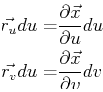
 is composed of a set of little parallelogram
patches with sides given by the infinitesimal vectors
is composed of a set of little parallelogram
patches with sides given by the infinitesimal vectors
 |
(15-2) |
 and
and  are not
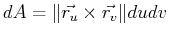
necessarily perpendicular, their cross-product is needed
to determine the
magnitude of the area in the
parallelogram:
are not
necessarily perpendicular, their cross-product is needed
to determine the
magnitude of the area in the
parallelogram:
 |
(15-3) |
 ,
on the surface is
,
on the surface is
However, the operation of taking the norm in the definition of
the surface patch  indicates that some information is getting
lost--this is the local normal orientation of the surface.
There are two choices for a normal (inward or outward).
indicates that some information is getting
lost--this is the local normal orientation of the surface.
There are two choices for a normal (inward or outward).
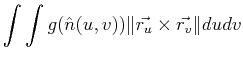
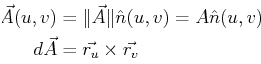
When calculating some quantity that does not have vector nature, only the magnitude of the function over the area matters (as in Eq. 15-4). However, when calculating a vector quantity, such as the flow through a surface, or the total force applied to a surface, the surface orientation matters and it makes sense to consider the surface patch as a vector quantity:
 |
(15-5) |
 is the local surface unit normal at
.
is the local surface unit normal at
.
MATHEMATICA Example
 |
| (notebook Lecture-15) |
| (html Lecture-15) |
| (xml+mathml Lecture-15) |
| Integrals of Anisotropic Surface Energy
The surface energy of single crystals often depends on the
surface orientation.
This is especially the case for materials that have covalent
and/or ionic bonds.
To find the total surface energy of such a single crystal, one has to integrate an orientation-dependent surface energy over the surface of a body. This example compares the total energy of such an anisotropic surface energy integrated over a sphere and a cube that enclose the same volume.
|
The above calculation compares two fixed shapes--to find the surface which has the least energy for enclosing a given volume, one would employ a construction known as the Wulff Theorem.

 and latitude
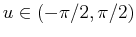 .
.