
 Next: Representations of Surfaces
Up: Lecture_15_web
Previous: Lecture_15_web
Next: Representations of Surfaces
Up: Lecture_15_web
Previous: Lecture_15_web
Reappraise the simplest integration operation,
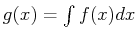 .
Temporarily ignore all the tedious mechanical rules of finding and
integral and concentrate on what integration does.
.
Temporarily ignore all the tedious mechanical rules of finding and
integral and concentrate on what integration does.
Integration replaces a fairly complex process--adding up all
the contributions of a function  --with a clever new function
 that only needs end-points to return the result of a complicated summation.
It is perhaps initially astonishing that this complex operation
on the interior of the integration domain can be incorporated merely by
the domain's endpoints.
However, careful reflection provides a counterpoint to this marvel.
How could it be otherwise?
The function
is specified and there are no surprises lurking
along the  -axis that will trip up
  as it marches merrily along between
the endpoints.
All the facts are laid out and they willingly submit to the process
their preordination by
by virtue of the endpoints.1
as it marches merrily along between
the endpoints.
All the facts are laid out and they willingly submit to the process
their preordination by
by virtue of the endpoints.1
The idea naturally translates to higher dimensional integrals and these are the basis for Green's theorem in the plane, Stoke's theorem, and Gauss (divergence) theorem. Here is the idea:
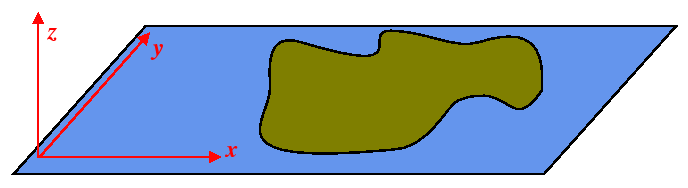

|
The analog of the ``Fundamental Theorem of Differential and
Integral Calculus''2 for a region
 bounded in a plane with
normal
bounded in a plane with
normal  that is bounded by a curve
 is:
is:
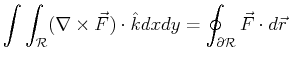 |
(15-1) |
The following figure motivates Green's theorem in the plane:
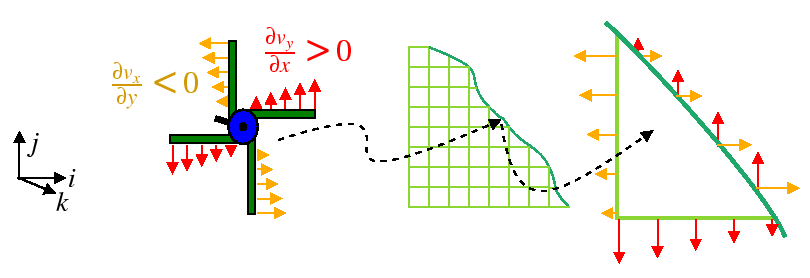
|
|
The generalization of this idea to a surface
 bounding
a domain
bounding
a domain
 results in Stokes' theorem, which will be discussed
later.
results in Stokes' theorem, which will be discussed
later.
MATHEMATICA Example
 |
| (notebook Lecture-15) |
| (html Lecture-15) |
| (xml+mathml Lecture-15) |
| Turing an integral over a domain into an integral over its boundary
Using Green's theorem in the plane to simplify the integration
to find the potential above a triangular path
that was evaluated in the last lecture.
Here we turn the two dimensional numerical integration which
requires
|
 over
over  .
If some other function,
.
If some other function,  , were specified on the plane,
then its integral is also determined by summing the contributions
along the boundary.
This is a generalization
, were specified on the plane,
then its integral is also determined by summing the contributions
along the boundary.
This is a generalization
 ) from one cell moves into
its neighbors; however, at the edges the local rotation is a
net loss or gain.
The local net loss or gain is
) from one cell moves into
its neighbors; however, at the edges the local rotation is a
net loss or gain.
The local net loss or gain is
 .
. calculations into an integration
around the boundary which requires
calculations into an integration
around the boundary which requires
 evaluations
for the same accuracy.
evaluations
for the same accuracy.


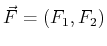 which matches
the integral in questions.
This can be done by simply setting
which matches
the integral in questions.
This can be done by simply setting  and integrating to
find
and integrating to
find 
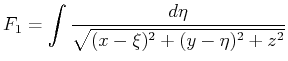
 from the three line segments and integrate over
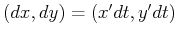 .
.