
 Next: Index
Up: Lecture_12_web
Previous: Total and Partial Derivatives, Chain Rule
Next: Index
Up: Lecture_12_web
Previous: Total and Partial Derivatives, Chain Rule
Scalar functions
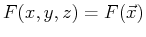 have a natural
vector field associated with them--at each point
have a natural
vector field associated with them--at each point  there
is a direction
there
is a direction
 pointing in the direction
of the most rapid increase of
pointing in the direction
of the most rapid increase of  .
Associating the magnitude of a vector in the direction of
steepest increase with the rate of increase of
defines
the gradient.
.
Associating the magnitude of a vector in the direction of
steepest increase with the rate of increase of
defines
the gradient.
The gradient is therefore a vector function with a vector
argument (
in this case) and it is commonly written as
 .
.
Here are some natural examples:
At any point on the map, there is a direction that points to local high pressure center--this is the direction of the gradient. The rate at which the pressure is increasing gives the magnitude of the gradient.
The gradient of pressure should be a vector that is related to the direction and the speed of wind.
In an isolated system,
heat flows from high-temperature (
 ) regions to
low-temperature regions.
) regions to
low-temperature regions.
The Fourier empirical law of heat flow states that the rate of heat flows is proportional to the local decrease in temperature.
Therefore, the local rate of heat flow should be a proportional
to the vector which is minus the gradient
of
:

Force is a vector.
Force projected onto a displacement vector  is the
rate at which work,
is the
rate at which work,  , is done on an object
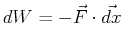 .
.
If the work is being supplied by an external agent (e.g., a
charged sphere, a black hole, a magnet, etc.), then it may
be possible to ascribe a potential energy (
 , a scalar
function with vector argument) to the agent
associated with the position at which the force is being
applied.1This
is the potential for the agent and the
force field due to the agent is
, a scalar
function with vector argument) to the agent
associated with the position at which the force is being
applied.1This
is the potential for the agent and the
force field due to the agent is
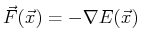 .
.
Sometimes the force (and therefore the energy) scale with the ``size'' of the object (i.e., the object's total charge in an electric potential due to a fixed set of charges, the mass of an object in the gravitational potential of a black hole, the magnetization of the object in a magnetic potential, etc.). In these cases, the potential field can be defined in terms of a unit size (per unit charge, per unit mass, etc.). One can determine whether such a scaling is applied by checking the units.