
 Next: Index
Up: Lecture_11_web
Previous: Vector Products
Next: Index
Up: Lecture_11_web
Previous: Vector Products
 , as a point in space.
If that vector is a function of a real
continuous parameter for instance,
, as a point in space.
If that vector is a function of a real
continuous parameter for instance,  ,
then
,
then
 represents the
loci as a function of a parameter.
represents the
loci as a function of a parameter.
If
is continuous, then it sweeps out
a continuous curve as
changes continuously.
It is very natural to think of
as time and
as the trajectory of a particle--such a trajectory would
be continuous if the particle does not disappear at one
instant,
, and reappear an instant later,  ,
some finite distance distance away from
.
,
some finite distance distance away from
.
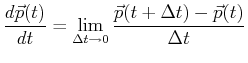
If
is continuous, then the limit:
 |
(11-5) |
 ,
,
 , etc.
MATHEMATICA Example
 |
| (notebook Lecture-11) |
| (html Lecture-11) |
| (xml+mathml Lecture-11) |
| Vector Derivatives
|
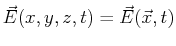 could be the
force on a unit charge located at
could be the
force on a unit charge located at  at time
.
at time
.
Here, there are many different things which might be varied and give rise to a derivative. Such questions might be:
 and at
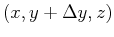 ?
vary
with time?
?
vary
with time?
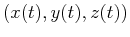 in space?
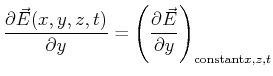
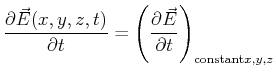
The first two questions are of the nature, ``How does a quantity change if only one of its variables changes and the others are held fixed?'' The kind of derivative that applies is the partial derivative.
The last question is of the nature, ``How does a quantity change when all of its variables depend on a single variable?'' The kind of derivative that applies is the total derivative. The answers are:
 |
(11-6) |
 |
(11-7) |
 |
(11-8) |
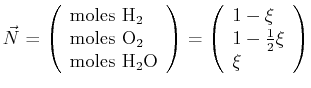
For example, consider the following chemical reaction:
| Reaction: |
H
|
 O O
|

|

|
| Initial: | 1 | 1 |
|
0 |
| During Rx.: | 
|

|
|

|
 |
(11-9) |
plays the role of the ``extent'' of the
reaction--so the composition variable  lives in
a reaction-extent (
) space of chemical species.
lives in
a reaction-extent (
) space of chemical species.