
 Next: Derivatives Vectors
Up: Lecture_11_web
Previous: Lecture_11_web
Next: Derivatives Vectors
Up: Lecture_11_web
Previous: Lecture_11_web
MATHEMATICA Example
 |
| (notebook Lecture-11) |
| (html Lecture-11) |
| (xml+mathml Lecture-11) |
|
Solution to 2D Diffusion Equation for Point Source Initial Conditions
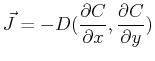
|
 |
(11-1) |
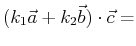
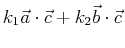

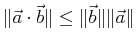
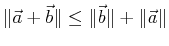
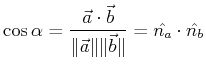
If the vector components are in a cartesian (i.e., cubic lattice) space, then there is a useful equation for the angle between two vectors:
 |
(11-2) |
 is the unit vector that shares a direction with
  .
Caution: when working with vectors in non-cubic crystal
lattices (e.g, tetragonal, hexagonal, etc.) the angle relationship above
does not hold.
One must convert to a cubic system first to calculate the angles.
.
Caution: when working with vectors in non-cubic crystal
lattices (e.g, tetragonal, hexagonal, etc.) the angle relationship above
does not hold.
One must convert to a cubic system first to calculate the angles.
The projection of a vector onto a direction  is a scalar:
 |
(11-3) |
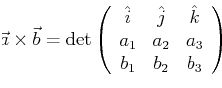
 ) differs from the dot (or inner) product
in that multiplication produces a vector from two vectors.
One might have quite a few choices about how to define
such a product, but the following idea proves to be
useful (and standard).
) differs from the dot (or inner) product
in that multiplication produces a vector from two vectors.
One might have quite a few choices about how to define
such a product, but the following idea proves to be
useful (and standard).
The exception is when the two vectors are linearly dependent; in this case the product vector will have zero magnitude.
The product vector is normal to the plane defined by the two vectors that make up the product. A plane has two normals, which normal should be picked? By convention, the ``right-hand-rule'' defines which of the two normal should be picked.
This has the extra utility that the cross product is zero when two vectors are linearly-dependent (i.e., they do not define a plane).
This also has the utility, discussed below, that the triple product will be a scalar quantity equal to the volume of the parallelepiped defined by three vectors.
|
MATHEMATICA
Example |
| (notebook Lecture-11) |
| (html Lecture-11) |
| (xml+mathml Lecture-11) |
| Example of a Cross Product
|
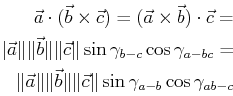
The triple product,
 |
(11-4) |
 is the angle between two vectors
and
is the angle between two vectors
and  and
and
 is the angle between the vector
  and plane spanned by
and
.
is equal to the parallelepiped that has
and plane spanned by
and
.
is equal to the parallelepiped that has  ,
,  , and
, and  ,
emanating from its bottom-back corner.
,
emanating from its bottom-back corner.
If the triple product is zero, the volume between three vectors is zero and therefore they must be linearly dependent.