Next: Index
Up: Lecture_06_web
Previous: Vectors
Next: Index
Up: Lecture_06_web
Previous: Vectors
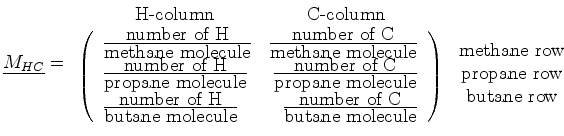
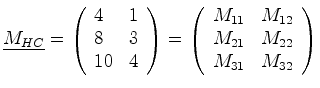
Consider methane (
CH ),
propane (
C
),
propane (
C H
H ),
and butane (
CH
),
and butane (
CH ).
).
 |
(06-11) |
 |
(06-12) |
 |
 number of methanes number of methanes number of propanes number of butanes number of propanes number of butanes |
(06-13) |
 |
(06-14) | |
 |
(06-15) |
 |
(06-16) |
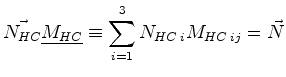
The ``summation'' convention is often used, where a repeated index is summed over all its possible values:
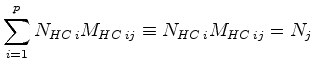 |
(06-17) |
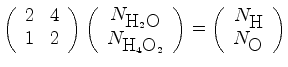
For example, suppose
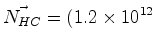 molecules methane molecules methane molecules propane molecules propane molecules butane molecules butane |
(06-18) |
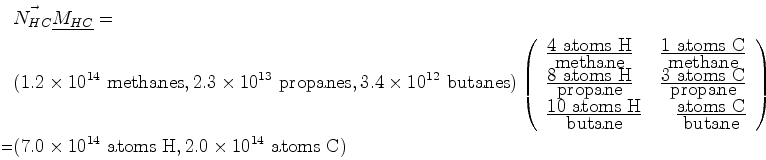 |
(06-19) |
Above the lists (or vectors) of atoms were stored as rows, often it is convenient to store them as columns. The operation to take a row to a column (and vice-versa) is a ``transpose''.
 |
(06-20) |
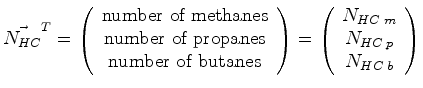 |
(06-21) |
 |
(06-22) |
MATHEMATICA Example
 |
||||||||
| (notebook Lecture-06) | ||||||||
| (html Lecture-06) | ||||||||
| (xml+mathml Lecture-06) | ||||||||
Matrices
Suppose that some process that produces hyrdocarbons
can be modeled with the pressure  and temperature
  .
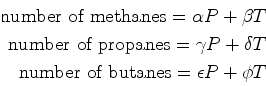
Suppose (this is an artificial example)
that the number of hydrocarbons produced in one millisecond
can be related linearly to the pressure and temperature:
.
Suppose (this is an artificial example)
that the number of hydrocarbons produced in one millisecond
can be related linearly to the pressure and temperature:
or
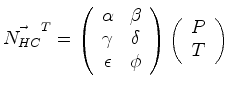
Then, if we wanted to find an operation that takes us from
the processing vector
Using matrix multiplication,
is a matrix, which when operating on a vector of pressure and temperature, returns a vector of the amount of hydrogen and carbon. |
Matrix multiplication is defined by:
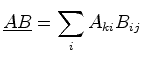 |
(06-27) |
 are
are  .
.
Sometimes what we wish to know, ``What vector is it ( ),
when transformed by some matrix (
),
when transformed by some matrix ( ) gives us a particular
result (
) gives us a particular
result (
 )?''
)?''
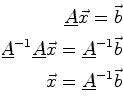 |
(06-28) |
The inverse of a matrix is defined as something that when multiplied with the matrix leaves a product that has no effect on any vector. This special product matrix is called the identidy matrix.
|
MATHEMATICA
Example |
||||
| (notebook Lecture-04) | ||||
| (html Lecture-04) | ||||
| (xml+mathml Lecture-04) | ||||
| Inverting Matrices
where
|
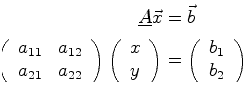 |
(06-31) |

|
MATHEMATICA
Example |
||
| (notebook Lecture-06) | ||
| (html Lecture-06) | ||
| (xml+mathml Lecture-06) | ||
Eliminating redundant equations or variables
Consider liquid water near the freezing point--dipole interactions
will tend to make water molecules form clusters such as
H O
and
H O
. O
and
H O
.
Then the mapping from molecules to the number of atoms becomes:
|
 to the number of hydrogens
and carbons:
to the number of hydrogens
and carbons: