
 Next: Matrices and Matrix Operations
Up: Lecture_06_web
Previous: Lecture_06_web
Next: Matrices and Matrix Operations
Up: Lecture_06_web
Previous: Lecture_06_web
 |
(06-1) |
 |
determines position | 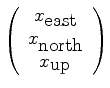 |
(06-2) |
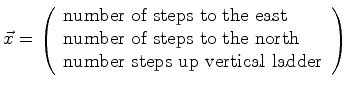
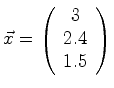
The vector above is just one example of a position vector.
We could also use coordinate systems that differ
from the Cartesian  to represent
the location.
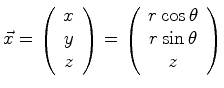
For example, the location in cylindrical coordinate system could
be written as
to represent
the location.
For example, the location in cylindrical coordinate system could
be written as
 |
(06-3) |
 .
.
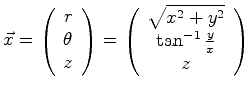
The position could also be written as a cylindrical, or polar vector
 |
(06-4) |
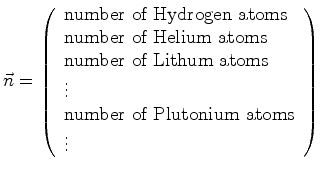
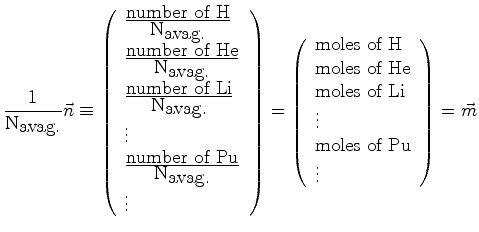
However, vectors need not represent position at all, for example:
 |
(06-5) |
 |
(06-6) |
 |
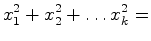 euclidean separation euclidean separation |
(06-7) |
 |
 |
(06-8) |
| unit direction vector | mole fraction composition | (06-9) | |
 |
 |
(06-10) |
| Extra Information and Notes
Potentially interesting but currently unnecessary |
If  stands for the set of all real numbers (i.e.,
0
,
stands for the set of all real numbers (i.e.,
0
,  ,
,  , etc.), then can use a shorthand to
specify the position vector,
, etc.), then can use a shorthand to
specify the position vector,
 (e.g., each of
the
(e.g., each of
the  entries in the vector of length
must be a real number--or
in the set of real numbers.
entries in the vector of length
must be a real number--or
in the set of real numbers.
 .
.
For the unit (direction) vector:
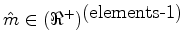
For the case of the composition vector, it is strange to consider
the case of a negative number of atoms, so the mole fraction
vector
|
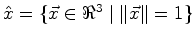 (i.e, the unit direction vector is the set of all position
vectors such that their length is unity--or, the unit
direction vector is the subset of all position vectors that
lie on the unit sphere.
(i.e, the unit direction vector is the set of all position
vectors such that their length is unity--or, the unit
direction vector is the subset of all position vectors that
lie on the unit sphere.
 and
and  have the same number
of entries, but compared to
have the same number
of entries, but compared to 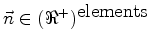 (
( is
the real non-negative numbers) and
is
the real non-negative numbers) and
 .
.