


Consider a pure liquid
 in contact with the
air. The degrees of freedom can be determined in
several equilvalent ways.
in contact with the
air. The degrees of freedom can be determined in
several equilvalent ways.
 and air and
restrict that the total pressure is 1 atm.
and air and
restrict that the total pressure is 1 atm.
 .
.
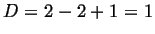 .
.
Considering that the system consists of
three components: ,
O ,
N
and has two additional restrictions: 1)
,
N
and has two additional restrictions: 1)

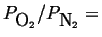 constant, then
 .
.
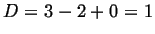 as before.
Disregard the air:  .
.  and
therefore
and
therefore  . The liquid has an equilibrium
vapor pressure which is a function of temperature.
One can pick either the vapor pressure or the
temperature independently, but not both.
. The liquid has an equilibrium
vapor pressure which is a function of temperature.
One can pick either the vapor pressure or the
temperature independently, but not both.