
 Next: Index
Up: Lecture_27_web
Previous: Lecture_27_web
Next: Index
Up: Lecture_27_web
Previous: Lecture_27_web
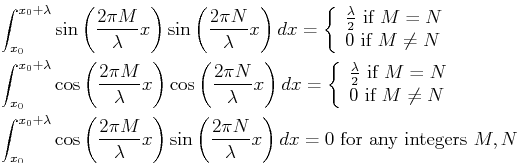
The trigonometric functions have the property that they are orthogonal, that is:
 |
(27-1) |
This property allowed the Fourier series to be obtained by multiplying a function by one of the basis functions and then integrating over the domain.
 for which
  and
and  have
a inner product defined) and integrated in their inner product definition.
have
a inner product defined) and integrated in their inner product definition.
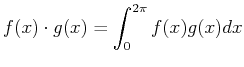
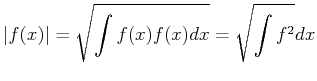
For the trignometric functions, the inner product was a fairly obvious choice:
 |
(27-2) |
 |
(27-3) |
However, there are different choices of inner products.
For example,
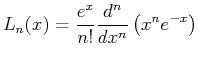
the Laguerre polynomials (or Laguerre functions)  defined by
 |
(27-4) |
 have the orthogonality relation for a weighted inner product:
 |
(27-5) |
Many ordinary differential equations--including the harmonic oscillator, Bessel, and Legendre--can be written in a general form:
 .
The function
.
The function  appears in the orthonormality relation:
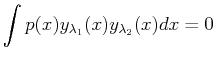 if if  |
(27-7) |
The same "trick" of multiplying a function by one of the eigensolutions and then summing a series can be used to generate series solutions as a superposition of eigensolutions.
MATHEMATICA Example
 |
| (notebook Lecture-27) |
| (html Lecture-27) |
| (xml+mathml Lecture-27) |
| Legendre functions
|
![$\displaystyle \ensuremath{\frac{d{}}{d{x}}}\left[ r(x) \ensuremath{\frac{d{y}}{d{x}}} \right] + \left[q(x) + \lambda p(x)\right] y(x) = 0$](img11.png)