
 Next: Index
Up: Lecture_26_web
Previous: Lecture_26_web
Next: Index
Up: Lecture_26_web
Previous: Lecture_26_web
Most calculators have a button that
evaluates the eigensolution to the
simple first-order ODE
 .
Also, most calculators have buttons that
evaluate the eigensolutions to the
simple second-order ODE:
.
Also, most calculators have buttons that
evaluate the eigensolutions to the
simple second-order ODE:
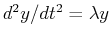 .
.
Of course, these are also just the exponential and trigonometric functions.
However, there are many more simple differential equations that
follow from physical models
and these also have known solutions that are not simple combinations
of sines, cosines, and exponentials.
The solutions to these differential equations are called special
functions.
MATHEMATICA has an extensive list of special functions and these are
collected in its help browser.
has an extensive list of special functions and these are
collected in its help browser.
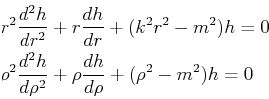
For example, the positions of a vibrating drum head are modeled with in cylindrical coordinates by Bessel's equation:
 .
The displacement of the drum is
.
The displacement of the drum is  ;
;  is related
to an inverse wavelength (e.g., the wavelength would be
the radius of the drum divided by the number of maxima in
the drum head shape) and
is related
to an inverse wavelength (e.g., the wavelength would be
the radius of the drum divided by the number of maxima in
the drum head shape) and  is the mode (e.g., the number
of maxima traversing the drum by
is the mode (e.g., the number
of maxima traversing the drum by  in a circular direction).
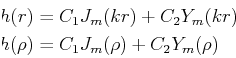
There two solutions to Bessel's equation and the general solution is the sum the two:
 is called (naturally enough)
an order-
Bessel function of the first kind
and
is called (naturally enough)
an order-
Bessel function of the first kind
and  is called (naturally enough)
an order-
Bessel function of the second kind.
These are analogous to the sines and cosines, but for
a different ODE.
is called (naturally enough)
an order-
Bessel function of the second kind.
These are analogous to the sines and cosines, but for
a different ODE.
Another equation that appears in models of the angular deformations of body in a central force potentials (for example, the ion distribution about a fixed charge; or, the Schrödinger equation for the electron in a hydrogen atom) in spherical coordinates is Legendre's equation:
 so that
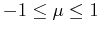 .
The value
.
The value  is related to the number of modes in the
 direction and
is related to the number of modes
in the
direction and
is related to the number of modes
in the  direction.
Legendre's equation has two solutions:
 is called (again, naturally enough)
order
Legendre functions of the first kind and
is called (again, naturally enough)
order
Legendre functions of the first kind and
 are called
order
are called
order  Legendre functions of the second kind.
There are many other types of special functions.
|
MATHEMATICA
Example |
| (notebook Lecture-26.tex) |
| (html Lecture-26.tex) |
| (xml+mathml Lecture-26.tex) |
| Visualizing special functions.
|
The Shrödinger for the electron in a hydrogen atom
is a partial differential equation--one that involves derivatives
with respect than more than one variable.
In the case of the hydrogen atom, the variables are the spherical
coordinates  and
.
and
.
A common method of solving a partial differential equation is to reduce it to a system of coupled ODEs by a method called separation of variables.
The solution for the wave-functions of an electron follows from
separation of variables and special functions arise in the
solution to the ordinary differential equations--including the
Legendre functions
 (which are part of the spherical
harmonics
(which are part of the spherical
harmonics
 ) and Laguerre
  functions.
The subscripts are associated with the quantum numbers that
give structure to the periodic table of elements.
functions.
The subscripts are associated with the quantum numbers that
give structure to the periodic table of elements.
|
MATHEMATICA
Example |
| (notebook Lecture-26) |
| (html Lecture-26) |
| (xml+mathml Lecture-26) |
| Visualizing the Hydrogen atom eigenfunctions
|
![\begin{displaymath}\begin{split}& \frac{1}{\sin \theta} \ensuremath{\frac{d{}}{d...
...ll (\ell +1) - \frac{m^2}{1 - \mu^2} \right] \Xi =0 \end{split}\end{displaymath}](img13.png)
