Next: Stability of Critical Points
Up: Lecture_25_web
Previous: Lecture_25_web
Next: Stability of Critical Points
Up: Lecture_25_web
Previous: Lecture_25_web
The behavior of systems of first-order equations can be visually interpreted by plotting
the trajectories
 for a variety of initial conditions
 .
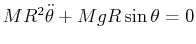
An illustrative example is provided by the equation for the pendulum,
.
An illustrative example is provided by the equation for the pendulum,
 .
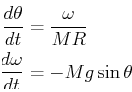
can be re-written with the angular momentum
.
can be re-written with the angular momentum  as the system of first-order ODEs
 |
(25-2) |
Behavior for a wide variety of initial conditions can be comprehended by the following approach:
 can be established, then
these fixed points can be used as reference points around which the phase-behavior will
be determined.
can be established, then
these fixed points can be used as reference points around which the phase-behavior will
be determined.
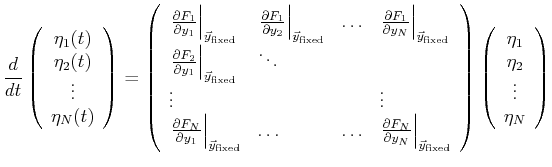
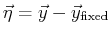 , the zeroth-order term vanishes by
construction:
, the zeroth-order term vanishes by
construction:
 has a trajectory that is unaffected
by the others and determined by only the diagonal entry associated with that
component.
has a trajectory that is unaffected
by the others and determined by only the diagonal entry associated with that
component.
The
are the eigenvectors of Eq. 25-4
and the diagonal component is its associated eigenvalue.
If the eigenvalue is imaginary, then the trajectory will circulate about the fixed point with a frequency proportional the eigenvalue's magnitude.
If the eigenvalue,  is complex, its trajectory will both circulate with a frequency
proportional to its imaginary part and diverge from or converge to the fixed point
according to
is complex, its trajectory will both circulate with a frequency
proportional to its imaginary part and diverge from or converge to the fixed point
according to
 Re
Re .
.
If any one of the fixed points has an eigenvalue with a positive real part, the fixed point cannot be stable--this is because ``typical'' points in the neighborhood of the fixed points will possess some component of the unstable eigenvector.
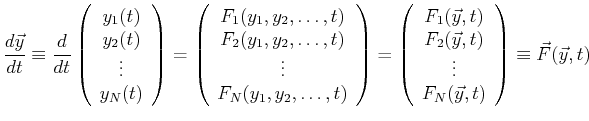
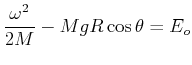
 .
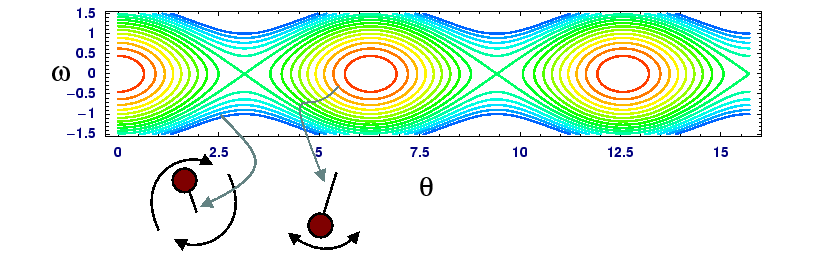
The larger orbits are those with increasing energy until the energy is just large
enough that the pendulum rises to its unstable equilibrium position
.
The larger orbits are those with increasing energy until the energy is just large
enough that the pendulum rises to its unstable equilibrium position
 .
The two kinds of fixed points (i.e., the stable and unstable points where
.
The two kinds of fixed points (i.e., the stable and unstable points where
 ) regulate the portrait of the phase plane.
(Note: The word ``phase'' here should not be confused with the common usage
of phase in materials science.
In the current context for example, the phase represents the positions
and momenta of all the particles in a system--this usage is important in
statistical mechanics.
) regulate the portrait of the phase plane.
(Note: The word ``phase'' here should not be confused with the common usage
of phase in materials science.
In the current context for example, the phase represents the positions
and momenta of all the particles in a system--this usage is important in
statistical mechanics.