Next: Index
Up: Lecture_23_web
Previous: Lecture_23_web
Next: Index
Up: Lecture_23_web
Previous: Lecture_23_web
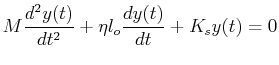
The physics of an isolated damped linear harmonic oscillator follows from the behavior of the homogeneous equation:1
The zero on the right-hand-side of Eq. 23-1 implies that
there are no external forces applied to the system.
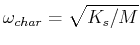
The system oscillates with a characteristic frequency
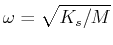 with amplitude that are damped by a characteristic time
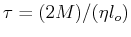 (i.e., the amplitude is damped
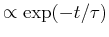 .)
.)
MATHEMATICA Example
 |
| (notebook Lecture-23) |
| (html Lecture-23) |
| (xml+mathml Lecture-23) |
| Simulating Resonance by Iteration and Noise
|
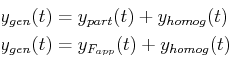
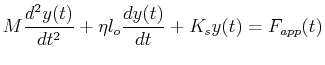
A general model for a damped and forced harmonic oscillator is
 represents a time-dependent applied force to the
mass
represents a time-dependent applied force to the
mass  .
.
 |
(23-3) |
 |
(23-4) |
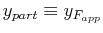 is the solution for the
particular
on the right-hand-side and
is the solution for the
particular
on the right-hand-side and  is
the solution for the right-hand-side being zero.
Adding the homogeneous solution
to the particular solution
is
the solution for the right-hand-side being zero.
Adding the homogeneous solution
to the particular solution
 is equivalent to
adding a ``zero'' to the applied force
is equivalent to
adding a ``zero'' to the applied force
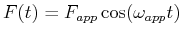
Interesting cases arise when the applied force is periodic
 , especially
when the applied frequency,
, especially
when the applied frequency,
 is close to the the characteristic
frequency of the oscillator
is close to the the characteristic
frequency of the oscillator
 .
.
For the case of a periodic forcing function, the time-dependent force can be represented by a Fourier Series. Because the second-order ODE (Eq. 23-2) is linear, the particular solutions for each term in a Fourier series can be summed. Therefore, particular solutions can be analyzed for one trigonometric term at a time:
There are three general cases for the particular solution:
| Condition | Solution for
|
|
| Undamped, Frequency-Mismatch |

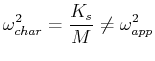
|

|
| Undamped, Frequency-Matched |
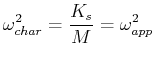
|
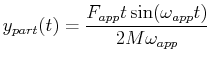
|
| Damped |

|
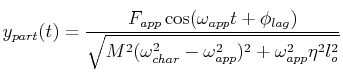
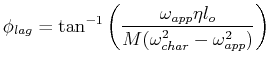
|
The phenomenon of resonance can be observed as the driving frequency approaches the characteristic frequency.
|
MATHEMATICA
Example |
| (notebook Lecture-23) |
| (html Lecture-23) |
| (xml+mathml Lecture-23) |
| Visualizing Solutions for the damped-forced harmonic oscillator
|
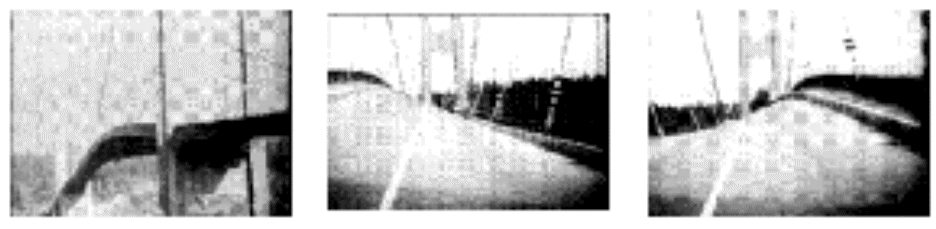
Resonance can have catastrophic or amusing (or both) consequences:
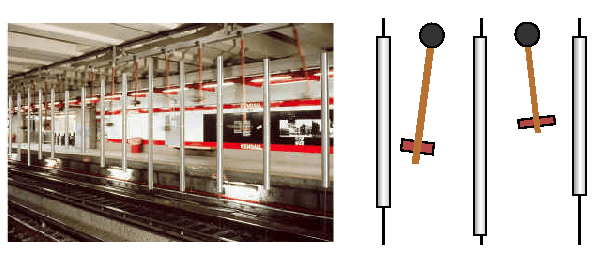

|
 |

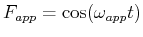 for initial conditions
that have a fixed displacement, but no initial momentum:
for initial conditions
that have a fixed displacement, but no initial momentum:
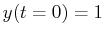 and
and
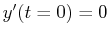 .
Let the function have input parameters for the mass,
viscosity, and characteristic frequency.
.
Let the function have input parameters for the mass,
viscosity, and characteristic frequency.