
 Next: Linear Transformations
Up: Lecture_07_web
Previous: Determinants
Next: Linear Transformations
Up: Lecture_07_web
Previous: Determinants
Consider the position vector
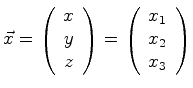 |
(07-12) |
The vectors  ,
,  , and
, and  can be
used to generate any general position by suitable scalar
multiplication and vector addition:
can be
used to generate any general position by suitable scalar
multiplication and vector addition:
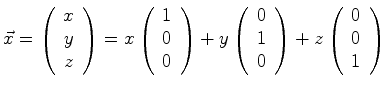 |
(07-13) |
Thus, three dimensional real space is ``spanned'' by
the three vectors:
,
, and
.
These three vectors are candidates as ``basis vectors for  .''
.''
Consider the vectors  ,
,  , and
, and  for
real
for
real  .
.
 |
(07-14) |
So
,
, and
for
real
also are basis vectors and can be
used to span
.
The idea of basis vectors and vector spaces comes up frequently in the mathematics of materials science. They can represent abstract concepts as well as shown by the following two dimensional basis set:
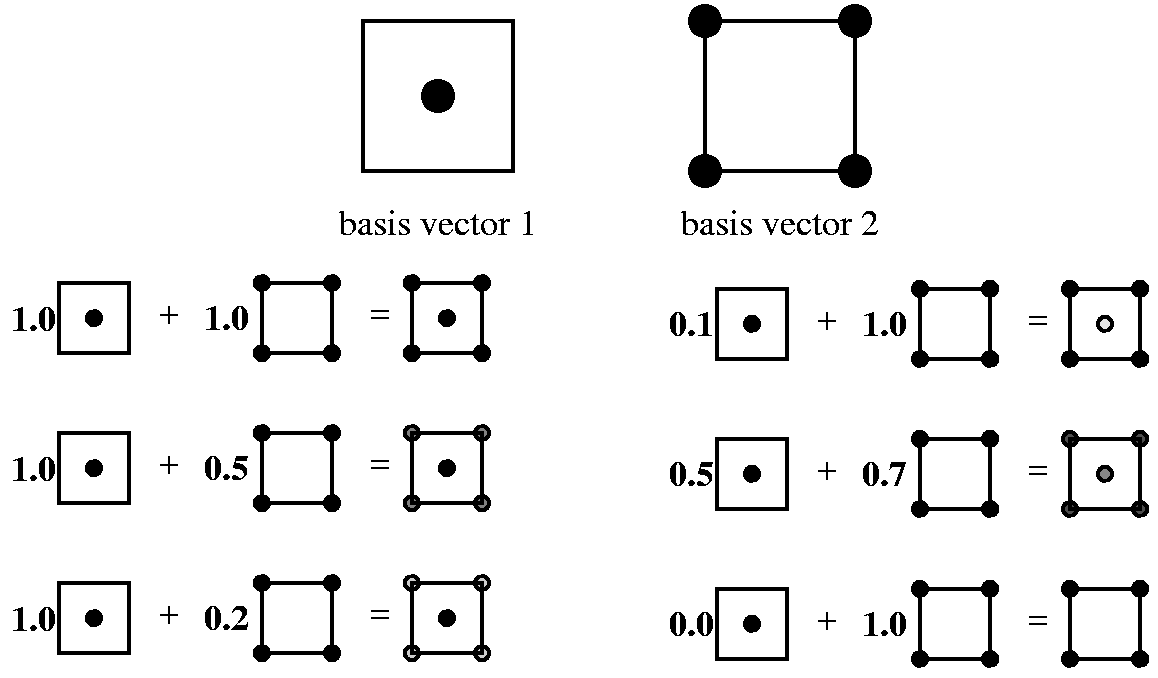

|