


|
Neumann's Principle
Any observable symmetry of a physical
property of a material must include the
symmetry elements of the point group of the
material.
|
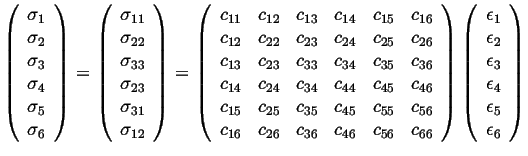
Consider how this couples to the condition of a positive definite Hessian in a thermodynamic system. In particular, consider a linear elastic material:1
 |
(25-1) |
 |
(25-2) |
 |
(25-3) |
Therefore the second derivative will contain terms such as,
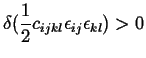 |
(25-4) |
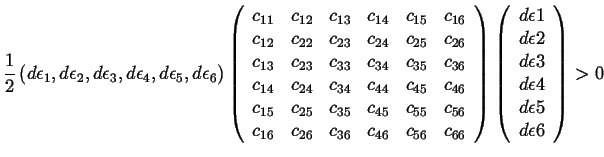 |
(25-5) |
The stiffness matrix that must be positive definite for an isotropic material is:
 |
(25-6) |
 and
and
 are the elastic Lamé coefficients and
are related to the isotropic elastic coefficients:
are the elastic Lamé coefficients and
are related to the isotropic elastic coefficients:
 |
(25-7) |
The matrix in Equation 25-6 has three unique eigenvalues:
![\bgroup\color{blue}$ E_{el}/[2(1+\nu)]$\egroup](img14.gif) ,
,
 , and
, and
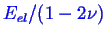 .
.
Therefore for an isotropic elastic material to be thermodynamically
stable, the
following conditions must be satisfied,
if
 then
then
 2Therefore,
 can be negative.
This is weird,
but true.
Cork has a small or almost negative Poisson's ratio, which
makes it easy to push into a bottle and makes a good seal.
can be negative.
This is weird,
but true.
Cork has a small or almost negative Poisson's ratio, which
makes it easy to push into a bottle and makes a good seal.
For a cubic material, the stiffness tensor is:
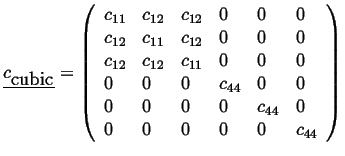 |
(25-8) |
 ,
,
 , and
, and
 .
.
The positive definite condition for a cubic elastic material is, then
 |
(25-9) |