Below it will be shown, for a multiphase system, that the chemical potential in each phase must be uniform and equal.
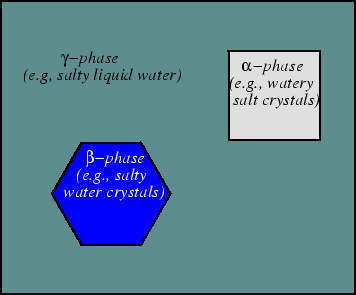
Consider the following simple multiphase system:
Application of the conditions of internal equilibrium
to the entire system considering that it is
composed of
 phases:
 |
(25-10) |
 is the chemical potential of chemical species
 in phase
 .
.
Write this out for a three (
 ) phase system composed of
two (
) phase system composed of
two (
 ) species
 and
and
 :
:
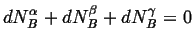
For a closed system,
 |
(25-11) |
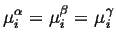
, therefore:
 |
(25-12) |
In other words, the chemical potentials of any chemical species is equal in all the present phases.
Or if we number the species
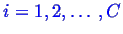 and
the number of phases
and
the number of phases
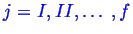 :
:
 |
(25-13) |
Each row has
 equal signs; i.e.
equations. So in the above there are
equal signs; i.e.
equations. So in the above there are
 equations.
In addition we have, via the Gibbs-Duhem equation for each phase, another relation between the variables:
 |
(25-14) |
equations.
Therefore,
Let the number of free variables be
 (degrees of freedom).
Then,
(degrees of freedom).
Then,
 |
(25-15) |
or:
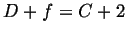 |
(25-16) |
 .
.
And this brings to mind the following..... limerick:
|
There was a recent graduate from MIT
Who was forced to send back her course three degree she couldn't make a phase plot Because she had simply forgot that P + F = 2 + C |
 and
and  are constant
and equilibrium with a reservoir.
are constant
and equilibrium with a reservoir.