


Consider
 , if I scale all the
extensive variables by multiplying each of the
extensive variables with the same
``scale factor''
, if I scale all the
extensive variables by multiplying each of the
extensive variables with the same
``scale factor''
 then
then
 |
(24-9) |
Functions that have the property of Equation 24-9, like
 , are called ``homogeneous degree one''
(HD1) function of their variables.
, are called ``homogeneous degree one''
(HD1) function of their variables.
Notice that
 is not a completely homogeneous
function:
is not a completely homogeneous
function:
 |
(24-10) |
However,
 |
(24-11) |
is HD1 only in the
 .
.
Notice that (here lies a common mistake!)
 |
(24-12) |
 is a different function than
.
is a different function than
.
Consider carefully, what can be deduced from Equation 24-11.
Taking the derivative with respect to
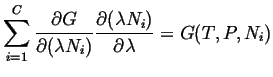 |
(24-13) |
We get the following very important equation:
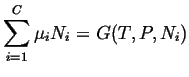 |
(24-14) |
This corresponds to what has been discussed about the relation of the Gibbs free energy. It corresponds to the internal degrees of freedom.