next up previous
Next: More Mathematical Thermodynamics: Homogeneous Up: Lecture_24_web Previous: Lecture_24_web

Equilibrium States With More Than One Variable

For a system of fixed composition, \bgroup\color{blue}$ \ensuremath{\delta}U(S,V)$\egroup can be expanded1

$\displaystyle \input{equations/17-3A}$ (24-1)

For a local equilibrium

$\displaystyle \input{equations/17-3B}$ (24-2)

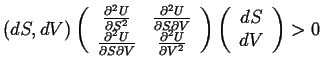
so that

$\displaystyle \input{equations/17-3C}$ (24-3)

The matrix is called the Hessian of the system and for the inequality to be true it must be ``positive definite'' for a two-by-two matrix.


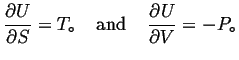
Necessary conditions for a local minimum are:

$\displaystyle \input{equations/17-4A}$ (24-4)

and

$\displaystyle \input{equations/17-4B}$ (24-5)

evaluated at the extrema.


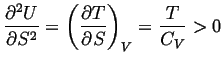
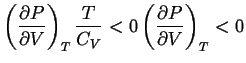
Therefore:

$\displaystyle \input{equations/17-4C}$ (24-6)

\bgroup\color{blue}$ C_V > O$\egroup for stability (If you add heat to a system, then its entropy must rise)

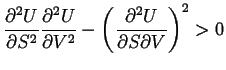
The second part (Eq. 24-5) that must also positive can be written in terms of the Jacobian
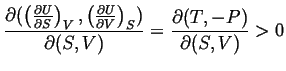
$\displaystyle \input{equations/17-4D}$ (24-7)


$\displaystyle \input{equations/17-5A}$ (24-8)

for a stable equilibrium.


next up previous
Next: More Mathematical Thermodynamics: Homogeneous Up: Lecture_24_web Previous: Lecture_24_web
W. Craig Carter 2002-11-14