The incremental work performed by a simple pure fluid is
 , so
, so
 .
.
Recall that
 is a state function:
Question: Can we simply integrate
 between two states,
say ``State A'' and ``State B'', and identify the work done by the body?
between two states,
say ``State A'' and ``State B'', and identify the work done by the body?
 |
(08-4) |
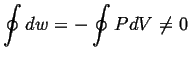
If Equation 8-4 were true, then for any ``work cycle'' (i.e., one that returns to its initial state--the initial state and the final state are the same.)
 |
(08-5) |
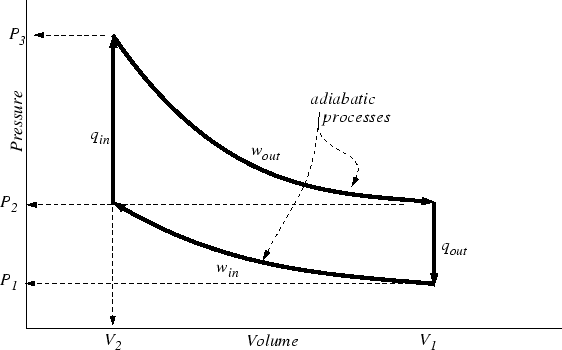
An idealized automobile engine can be represented by the following
 -path:
 |
(08-6) |
is sometimes called ``not a perfect
differential'' because of this property.
It simply means that you need even more
information to integrate it--namely the
path:
 is ``path dependent''.
Furthermore, the idealization in Figure 8-1 is a somewhat misleading.
It is easy to specify what the volume is in
such a system, but what about the pressure,
 ,
just after the beginning of the ``spark?''
The pressure is not uniform throughout the piston cylinder
and cannot be represented by
a point--so the curve cannot be represented by
a series of points.
,
just after the beginning of the ``spark?''
The pressure is not uniform throughout the piston cylinder
and cannot be represented by
a point--so the curve cannot be represented by
a series of points.
The idealization in Figure 8-1 introduces the topic of reversibility. (Sometimes, the terms quasi-equilibrium or quasi-static are used, they are effectively synonyms for reversible processes).
During a quasi-static process, all of the intensive variables are approximated as uniform; so it is possible to use one value and represent it on a graph such as Figure 8-1. However, it is important to realize that the quasi-static case is a limiting case that can be realized only if the system moves slowly enough to that all the intensive variables can adjust to their equilibrium values. This would be an efficient automobile engine, but the upper limit of its horsepower would be zero.
 for a standard automobile engine.