| Kinetic Processes in Materials |
| 3.21 Spring 2002 |
| Samuel M. Allen and W. Craig Carter |
| Department of Materials Science and Engineering |
| Massachusetts Institute of Technology |
| 77 Massachusetts Ave. |
| Cambridge, MA 02139 |
Exercise 7.1
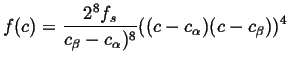
Use the symmetric molar regular free energy of mixing
for a binary alloy of  and
and  at fixed pressure.
![\begin{displaymath}\begin{split}\ensuremath{\overline{\ensuremath{{\Delta G}^{\m...
...ath{X_A}+ \ensuremath{X_B}\log \ensuremath{X_B}}) ] \end{split}\end{displaymath}](img4.gif) |
(1) |
 in terms of
 and
and
 .
.
 to
to  .
.
 for
for
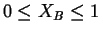 .
versus
.
versus
 for
.
for
.
Exercise 7.2
Consider the stagnation problem associated with the disappearance of
a nearly cylindrical grain in a thin sheet with thickness  .
.
 |
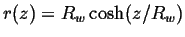 is
the equilibrium shape of the grain boundary if all interfaces are isotropic.
is
the equilibrium shape of the grain boundary if all interfaces are isotropic.
 . Note that
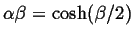 has two solutions when
 ,
,
 and
and
 .
.
ceases to have any solutions when
 .
What happens to the grain when
.
What happens to the grain when  deceases to about 3/4 ?
Exercise 7.3
Calculating the fastest growing and smallest unstable wavelengths
for a cylinder
which is evolving due to surface diffusion.
Start with a uniform cylinder and perturb with an infinitessimal pertubation
 . Use the small slope approximation
for the surface diffusion equation:
. Use the small slope approximation
for the surface diffusion equation:
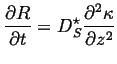
 and maximize with respect to
  .
.
Exercise 7.4
Determine the fastest growing and smallest unstable wavelengths
(if they exist) for:
 with homogeneous free energy density:

 with homogeneous free energy density: