| Kinetic Processes in Materials |
| 3.21 Spring 2002 |
| Samuel M. Allen and W. Craig Carter |
| Department of Materials Science and Engineering |
| Massachusetts Institute of Technology |
| 77 Massachusetts Ave. |
| Cambridge, MA 02139 |
Exercise 1.1
Please solve Excercise 2.2 in KPIM.
Exercise 1.2
Please solve Excercise 3.1 in KPIM.
Exercise 1.3
Please solve Excercise 3.2 in KPIM.
Exercise 1.4
Please solve the following problem that has previously
appeared on a 3.21 exam:
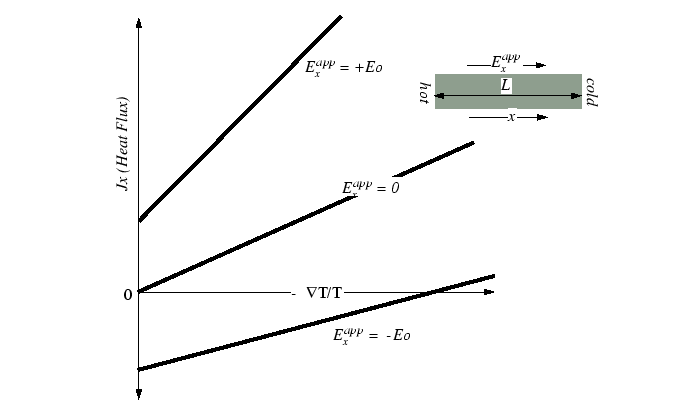
Consider a material that can conduct both heat and charge.
 and
and
 , respectively.
 . Would
you expect the charge flux at a fixed field to
increase, or decrease, with increasing thermal gradient
. Would
you expect the charge flux at a fixed field to
increase, or decrease, with increasing thermal gradient  ?
?
Exercise 1.5
This is a question that can many different forms of solution and variable degress of completeness. Such questions may require that you and your homework group make and justify physical assumptions, or some type of simulation, or data extraction.
Consider diffusion in a binary solid solution of components  and
and  .
The - alloy forms a regular solution with regular solution
parameter
.
The - alloy forms a regular solution with regular solution
parameter
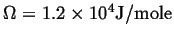 , and the diffusion
temperature is
, and the diffusion
temperature is
 .
.
Simulate diffusion by assuming the diffusion mechanism is direct
exchange of near-neighbor pairs of atoms. Furthermore, assume that the
jump frequencies for -, -, and - pairs have the
ratio  .
.
On the basis of your simulation results, what conclusions can you draw
about the relative magnitudes of the Onsager coefficients  ,
,
 ,
,  , and
, and  ?
?