Bravias Lattices
While atoms may be arranged in many different ways, there are fourteen basic types, known as the Bravais Lattices. They all represent possible unit cells.
Some things to know: The elements are in certain phases at room temperature.
(s)=solid, (l)=liquid, (g)=gas
a, b, and c all represent the three axis of the crystal. The angles α, β, and γ represent the angle across from the respective axis (α is across from a, as in the picture below)

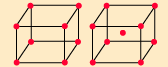
Cubic
all three directions have the same period, and are all orthogonal.
a=b=c, α=β=γ=90°
Period (a) related to atomic radius (r) by a=2r
Coordination number: 6
Examples: Polonium(s), Oxygen (g), Fluorine (g)

Body-Centered Cubic (BCC):
a=b=c, α=β=γ=90°
Period (a) related to atomic radius (r) by a=4r/√3
Coordination number: 8
APF: .68
Examples: Lithium (s), Sodium (s), Potassium (s), Vanadium (s), Chromium (s), Iron (s), Rubidium (s), Niobium (s), Molybdenum (s), Cesium (l), Barium (s), Europium (s), Tantalum (s), Tungsten (s), Francium (g), Radium (s), Manganese (s)

Face Center Cubic (FCC):
a=b=c, α=β=γ=90°
Period (a) related to atomic radius(r) by a=2r√2=4r/√2
Coordination number: 12
APF=.74
Examples: Neon (g),
Aluminum (s),
Silicon (s),
Argon (g),
Calcium (s),
Nickel (s),
Copper (s),
Germanium (s),
Krypton (g),
Strontium (s),
Rhodium (s),
Palladium (s),
Silver (s),
Xenon (g)
Cerium (s),
Ytterbium (s),
Iridium (s),
Platinum (s),
Gold (s),
Lead (s),
Radon (g),
Actinium (s),
Thorium (s).

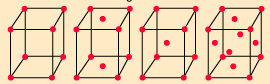
Tetragonal:
a=b≠c, α=β=γ=90°
Examples: Indium (s),
Tin (s)
Orthorhombic:
a≠b≠c, α=β=γ=90°
Examples: Chlorine (g),
Galium (l),
Bromine (l),
Iodine (s),
Uranium (s),
Neptunium (synthetically prepared),
Sulfur (s),
Protactinium (s).
Rhombohedral:
a=b=c, α=β=γ≠90°
Examples: Boron (s),
Antimony (s),
Samarium (s),
Mercury (l),
Bismuth (s),
Arsenic (s).
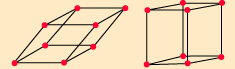
Monoclinic:
a≠b≠c, α≠90°, β=γ=90°
Examples: Plutonium (synthetically prepared)
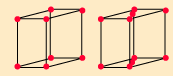
Triclinic:
a≠b≠c, α≠β≠γ≠90°

Hexagonal:
a=b≠c, α=β=90°, γ=120°
Coordination number and atomic packing factor are the same as FCC.
Hexagonal close packed Examples: Hydrogen (g), Helium (g), Beryllium (s), Magnesium (s), Cobalt (s), Zinc (s), Yttrium (s), Zirconium (s), Ruthenium (s), Cadmium (s), Tellurium (s), Gadolinium (s), Terbium (s), Dysprosium (s), Holmium (s), Erbium (s), Thulium (s), Lutetium (s), Hafnium (s), Rhenium (s), Osmium (s), Thallium (s), Scandium (s), Titanium (s), Phosphorus (s).
Most elements that are hexagonal are hexagonal close packed, except for: Carbon (s), Nitrogen (g), Lanthanum (s), Praseodymium (s), Neodymium (s), Promethium (synthetically prepared), Curium (synthetically prepared), Berkelium (synthetically prepared), Californium (synthetically prepared), Einsteinium (synthetically prepared), Americium (synthetically prepared), Selenium (solid).